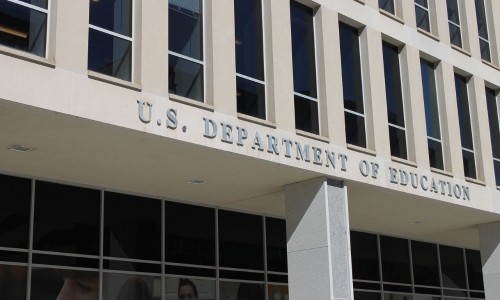
 On July 7, the US Department of Education (ED) and the Office of the Inspector General (OIG) hosted the first Higher Education Fraud Summit, bringing together over 800 financial aid administrators, institutions, law enforcement officials, inspectors general, and industry partners to discuss the federal response to rising student aid fraud. Following the roll out of real-time fraud detection efforts on the Free Application for Federal Student Aid (FAFSA) in late April, the Summit provided an early look at the system’s efficacy and an overview of how other federal agencies are addressing fraud.
(FSA) officials reported that the agency has rejected more than 53,000 fraudulent FAFSAs since April, prevented over $212 million in aid disbursements to bad actors, and identified more than $1 billion in fraudulent applications for the 2026-27 FAFSA cycle. A data-sharing partnership with the Social Security Administration accounts for roughly half of ED’s more than $2 billion in prevented fraud. Agency leadership repeatedly highlighted the importance of these efforts in light of the Pell Grant shortfall, emphasizing that ED’s work will help ensure that student aid dollars are disbursed to real students with real financial need.
Speakers underscored that the fraud landscape has changed in recent years – becoming both more frequent and more complex. The FAFSA Simplification and FUTURE Acts significantly reduced fraud through false data by pulling information directly from the IRS. What remains, explained FAFSA Director, Aaron Lemon-Strauss, is identity fraud. Fraud schemes often target institutions that share three common characteristics:
- Low-cost: Bad actors target institutions with tuition that falls below federal loan and grant limits.
- Open access: Fraudsters focus on this sector for immediate, easy enrollment.
- Online: Online options present opportunities for attendance via artificial intelligence (AI) bots, increasing ease of access for international crime rings.
The expansion of online learning during the COVID-19 pandemic, combined with advances in AI, have created new opportunities for these schemes, often led by those outside the country.
| Risk Level |
ED Response |
| Low Risk |
FAFSA is processed normally. No friction for legitimate citizens. |
| Moderate Risk |
FAFSA is processed normally, but institutions receive a notification that the application contains fraud indicators. Institutions can conduct their own verification. |
High Risk
(3% of users) |
The applicant must come on camera to show a valid government-issued ID. If they fail, the FAFSA is rejected. Schools receive FAFSA data and can override. If they pass, they continue on, and schools are told they’ve completed the process. The high-risk code goes away once a student successfully shows ID. |
Highest Risk
(<1% of users) |
FAFSA is rejected. School can override but will be audited if they do. |
Lemon-Strauss walked attendees through ED's new real-time fraud detection process. Before processing a FAFSA, ED evaluates:
One key takeaway from the Summit was that federal agencies are moving away from a “pay and chase” model and working to identify how fraud can be prevented before funds are disbursed. Under the new FAFSA initiatives, ED places applicants into one of four risk categories. For more information, see ED’s electronic announcement.
Lemon-Strauss acknowledged that a small number ofSo far, he said, the rate of institutional overrides is about what FSA expected. NCAN is not aware of any students who have been misidentified as fraudulent actors since the process began in April.
Beyond the specifics of the FSA process, panelists emphasized the importance of frequent cross-agency communication, as bad actors often target several federal agencies at once, stealing identities of low-income Americans.
Although the Summit focused on best practices and coordination for federal agencies, Congress is also considering legislation related to student aid fraud. One June 10, the US House of Representatives passed the No Aid for Ghost Students Act, which would require FSA to maintain an identity fraud prevention system and establish procedures to identify institutions with patterns of suspected identity fraud. Many of the provisions would codify the initiatives ED has already implemented. While the bill has not yet advanced in the Senate, the National College Attainment Network will continue to monitor its progress and advocate for strong safeguards that minimize false positives and ensure students and institutions have a clear, efficient process for resolving incorrectly flagged applications.