Did you take courses for college credit back when you were in high school? You likely had the opportunity to enroll in Advanced Placement (AP) or International Baccalaureate (IB) courses that required late night study sessions to prepare for a high-stakes, end-of-year exam, whose score would determine if you’d receive college credit. Oh, how times have changed! Today, the main driver that allows students to earn college credit in high school is dual enrollment.
Students who take dual enrollment courses typically do so through a partnership between their high school or district and a local community college. In the 2022-23 academic year, more than 2.8 million students enrolled in dual enrollment courses. This number doubled from what it was 10 years ago and continues to grow. But is dual enrollment making a difference in students’ willingness to enroll in college and complete their degrees? Let’s take a look at what the research says.
College Enrollment
Findings from the Community College Research Center’s (CCRC) study of students who began taking dual enrollment courses in 2015 discovered that 81% of these students enrolled in college within one year after high school graduation. That’s 11 percentage points higher than the national average of about 70%!
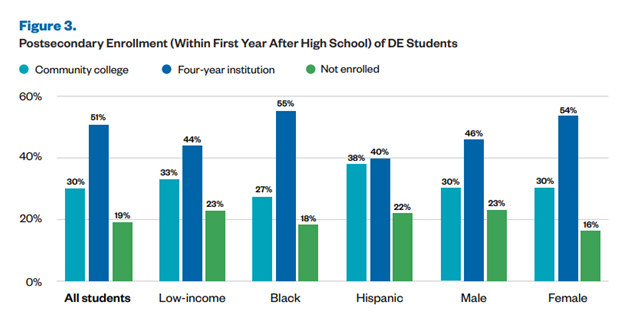
However, before students enroll in college, they first need to take the step to apply. This initial task can be daunting and confusing for students and is something direct admissions programs try to help streamline. A study analyzing students’ college application choices and admissions outcomes found students with dual enrollment credits applied to more colleges overall and more selective four-year institutions in the state they reside. Specifically, the study found that each additional dual enrollment course attempted by 11th and 12th graders not only increased these students’ likelihood of applying to at least one highly selective four-year institution by almost 7%, but increased their likelihood of being admitted to these schools by about 4%.
College Completion
Getting students through the doors of the ivory tower doesn’t guarantee they will complete their degrees, and dual enrollment appears to have a lasting effect on students’ college completion rates. In the same CCRC study, dual enrollment students had a two-point edge in bachelor’s degree completion versus their non-dually enrolled peers four years after high school (36% vs. 34%). This gap was even greater for low-income (+8% points), Black (+11% points), and Latino/a (+6% points) students.
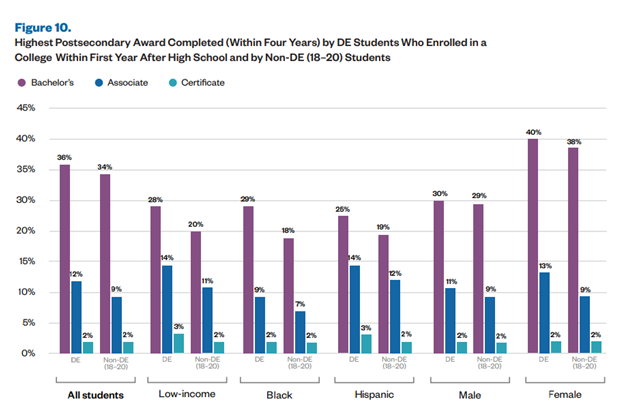
These national college completion numbers vary greatly by state. Some standout states such as Georgia, Mississippi, and Nevada boast an 18-19 percentage point difference in postsecondary award completion rates between dual enrollment students and non-dual enrollment students. Others like the District of Columbia and Rhode Island see negative percentage point differences between their dually enrolled students and non-dually enrolled students, meaning students who did not participate in dual enrollment in high school fared better when it came to completing a postsecondary degree.
Dual enrollment programs differ from state to state, but little research exists about what makes dual enrollment successful. To help answer this question, Alex Perry from the College in High School Alliance shared some practical advice from his co-authored Creating Better Dual Enrollment Governance report for states to consider.
What can states do to advance successful dual enrollment programs?
Perry outlined a three-step approach for states to consider:
- Have a vision. Think about what your state wants to get out of this system. Do you want to make college more affordable for students? More accessible? Both? Having a vision beyond simply wanting more dual enrollment is critical to garnering success.
- Ensure equitable access. Research shows that white and female students, in addition to those whose parents hold bachelor’s degrees, are overrepresented in dual enrollment programs. Because these students are likely to attend college even without dual enrollment credits, this raises questions about whether current investments are being utilized effectively. States should prioritize policies that expand access for underrepresented students. For example, Texas’ Financial Aid for Swift Transfer (FAST) program provides funding equal to the FAST tuition rate for each dual credit hour completed by a student who qualifies for free/reduced-price lunch. By tying funding to the participation and completion of students from low-income backgrounds, Texas’ approach incentivizes programs to both enroll and support these students to the completion of their dual enrollment courses.
- Foster intentional dual enrollment courses. Ensuring students have meaningful dual enrollment experiences means that the courses they take will help them advance on a pathway towards a credential or degree aligned with what they want to do after high school. Students and families want to save time and money when it comes to college, but this only happens when courses are transferable and relevant. For example, Indiana’s College Core offers students a block of dual enrollment courses that are universally transferable and applicable across the state. This clarity from the state-level removes friction points in the dual enrollment credit transfer process, maximizing students’ ability to save on the cost of and time it takes to complete a postsecondary degree.
How can states build partnerships to strengthen dual enrollment programs?
Strong dual enrollment programs rely on true partnerships between high schools and colleges that center student success rather than operating as transactional exchanges for credit. For these partnerships to work, both sides need clear incentives and responsibilities. Tensions can arise when one side of the partnership is expected to take on the cost of dual enrollment which can limit participation or strain relationships. States can address this by dedicating funding for dual enrollment, ensuring high schools nor colleges bear a disproportionate financial burden and allowing both to focus on expanding access and supporting students.
States can also strengthen partnerships by simplifying and streamlining collaboration. Clear guidance can reduce administrative burden, which is especially important for programs that are minimally staffed. For example, Illinois provides a model partnership agreement that outlines the terms of high school-college dual enrollment partnerships. Resources like this can prevent confusion, reduce friction, and free up staff capacity to focus on students.
What are some of the pitfalls states should avoid?
- Don’t create tension points between high schools and colleges. Clear guidelines and processes can strengthen these partnerships.
- Don’t limit the goal of dual enrollment solely to expanding access to postsecondary education. Think big! How could you also effectively reduce the cost of and time to a degree or credential, for example?
- Don’t chase the sugar high of students who would typically enroll in dual enrollment credits. Think about which students would benefit the most from completing dual enrollment courses and what it would take in terms of policy and funding incentives to make that happen.
By providing students with opportunities to take courses for college credit in high school, dual enrollment can strengthen the connection between high school and college. Importantly, the benefits of dual enrollment depend on how programs are designed and implemented. Having a clear vision, ensuring equitable access, and fostering intentional dual enrollment courses all play a role in determining whether students truly benefit from these opportunities.
The research is clear: when implemented well, dual enrollment can be a powerful strategy to expand postsecondary access and success. By providing students with opportunities to take courses for college credit in high school, students are more likely to apply to and enroll in college, and in many states, these students are more likely to persist once they get there. As states continue to expand these programs, ensuring equitable access and strong program quality will be key to making sure dual enrollment works for all students.
The National College Attainment Network (NCAN) would like to thank Alex Perry for sharing his time and expertise with the NCAN community and the field.