A new field report from The Urban Assembly offers early implementation data on CounselorGPT, an artificial intelligence (AI)-enabled advising tool piloted in its network of New York City schools. The report is preliminary and covers the first 60 days of rollout but makes an encouraging case. Essentially: students increase their engagement with postsecondary advising when access to it isn’t constrained by bell schedules and counselor availability.
CounselorGPT is billed as a “co-pilot” for school counselors and a “24/7 postsecondary advisor” for students. It uses large language models (“LLMs”, read: “AI”) that incorporate large national datasets (e.g., IPEDS, Peterson, College Scorecard, Lightcast) to help answer students’ questions whenever they have them.
The Urban Assembly estimates that most students get approximately 41 minutes of advising per year, based on national student-to-counselor ratios. The report returns repeatedly to this figure. After all, it's hard to build a college-going culture on a single 41-minute conversation, or even a handful of them, spread across four years.
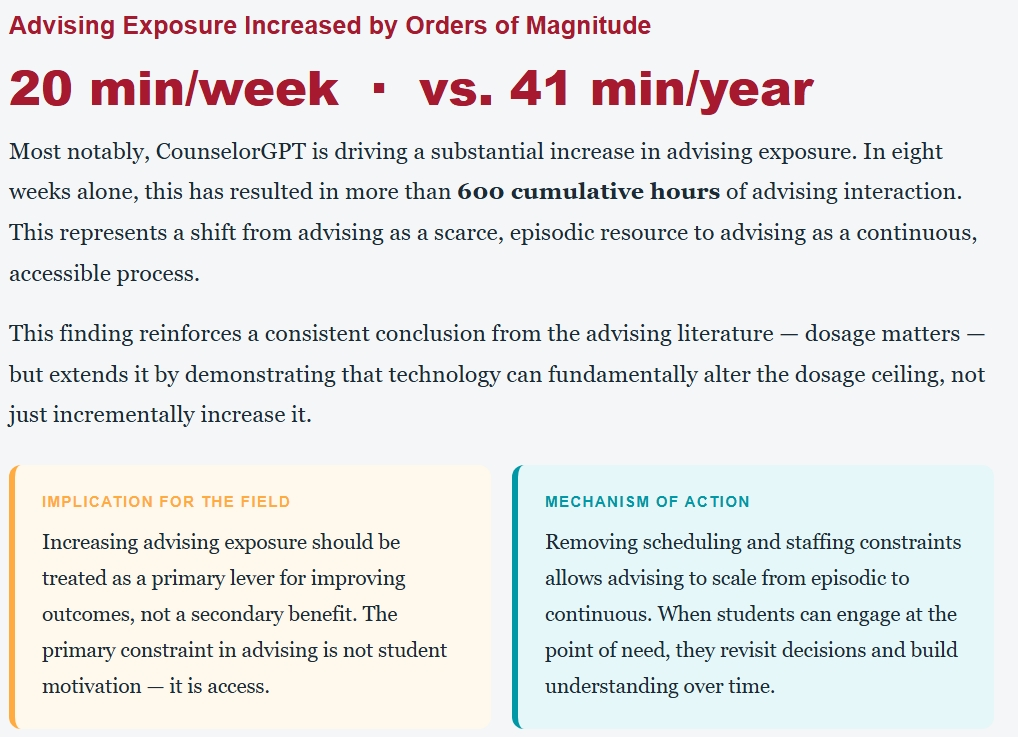
CounselorGPT's hypothesis is that the delivery model, not student motivation and appetite for advising, is the primary constraint. The 60-day pilot data are intended to test that claim.
Here are the four big findings:
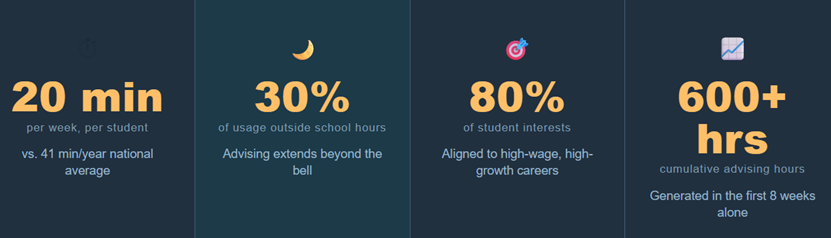
- Students offered CounselorGPT engaged with the platform for 20 minutes per week. The Urban Assembly contrasts that with its 41 minutes per year national average.
- 30% of the usage of CounselorGPT came outside of school hours. It suggests at least some students are returning to the tool voluntarily, not just when a class period is structured around it.
- 80% of student interests aligned with high-wage, high-growth careers. The report attributes this in part to the tool embedding labor market data directly into the career exploration experience, making salary projections and affordability information visible at the moment students are considering options rather than in a separate session for which they have to wait.
- CounselorGPT provided more than 600 hours of additional postsecondary advising in the trial period
The challenge with constraints on counselor and advisor bandwidth, capacity, etc. is that those constraints limit systems’ ability to get the right dosage of advising to students. If you underdose on antibiotics, you don’t get the result you want. Same thing with postsecondary advising. The research on advising interventions is pretty consistent on this point. More contact, more frequently, tends to produce better outcomes. The report cites Bettinger and Baker's 2014 work on student coaching as one example.
School and system conditions really mattered
One finding that deserves attention from district leaders: outcome variation in this pilot is driven less by student characteristics and more by differences in adult system design. Schools with structured staff onboarding, clear role ownership, and protected advising time showed higher adoption and deeper engagement. Schools without those conditions showed weaker results.
This is not surprising: technology can expand capacity, but it doesn't compensate for organizational gaps. Tools like this tend to get evaluated on their features. The harder work like who owns implementation, what training looks like, how time for school staff gets protected, tends not to get the same amount of attention or energy.
There’s more to come from CounselorGPT; what to watch for
Sixty days of implementation data can establish patterns of engagement, but it’s not a slam dunk on causal impact on postsecondary outcomes. The questions that matter for the field, like “does increased advising dosage predict better enrollment decisions match quality, and persistence?”, “does expressed career interest translate into actual applications?”, “are historically underserved students engaging at equitable rates?” all require longitudinal data the report doesn't yet have.
It's also worth flagging that the current data come entirely from Urban Assembly schools in New York City, so we don’t know a lot about generalizability yet like how this model would perform across different district contexts, student demographics, and implementation fidelity levels.
The field has spent years trying to scale high-quality advising without meaningfully changing the structural conditions that make quality advising hard to deliver. If AI-assisted tools can shift the dosage ceiling, it’s worth paying attention to.
The 60-day data are a starting point. The National College Attainment Network (NCAN) will be watching what the next phase of evidence shows and continuing to highlight other promising tech-enabled tools and approaches in the access and attainment field.
Questions or reactions? Reach out to me at [email protected] - I’d love to talk!