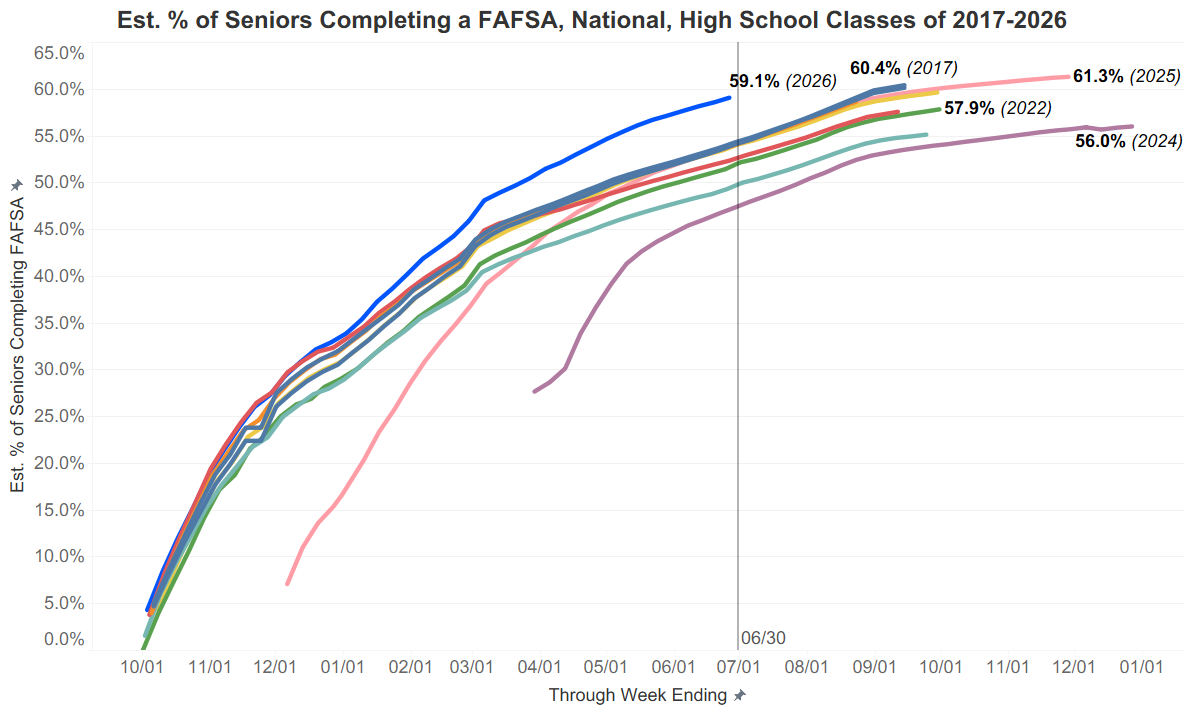
The high school class of 2026 has done it! With a 59.1% Free Application for Federal Student Aid (FAFSA) completion rate through June 26, graduating seniors have set a new record, exceeding the previous high by nearly five percentage points. The achievement represents a tremendous victory for college access advocates across the United States and realizes the promise of the simplified FAFSA, for which the National College Attainment Network (NCAN), our members, and many partners long advocated.
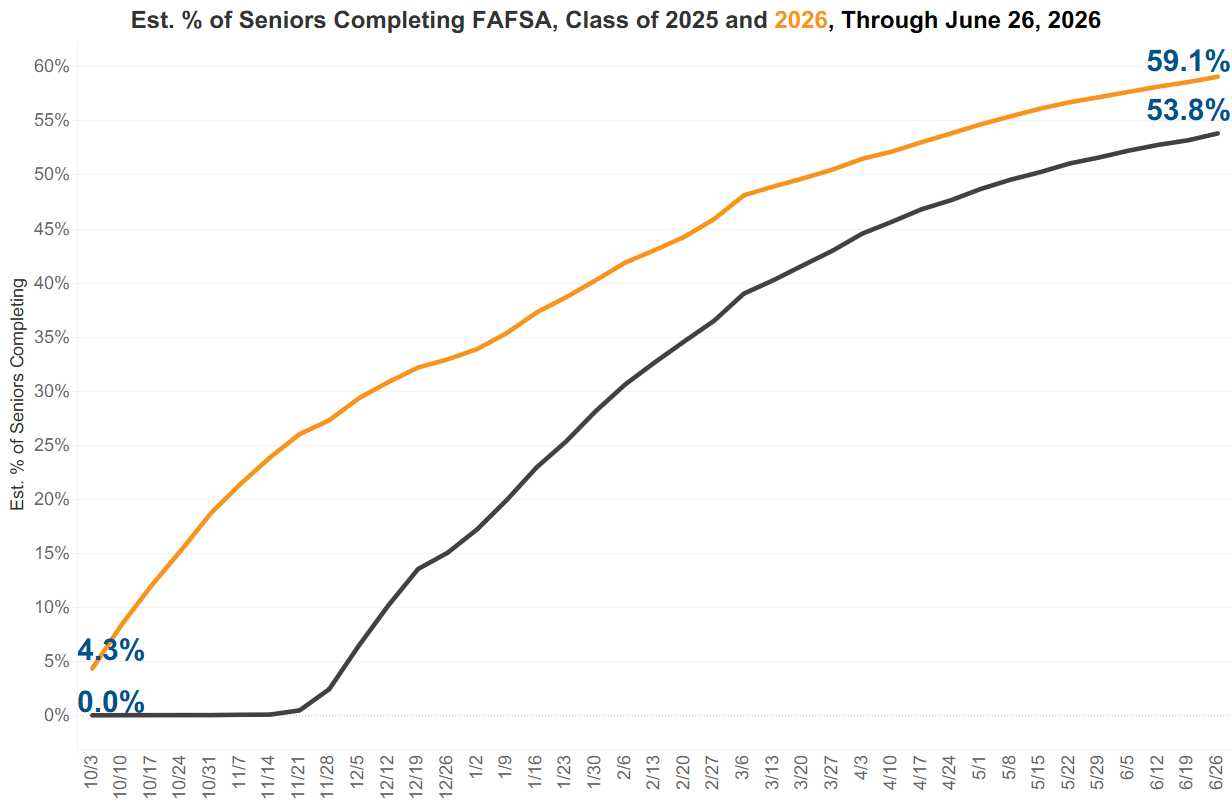
The previous national FAFSA completion rate record was 54.4% by the high school class of 2018.
“FAFSA simplification shows what is possible when bipartisan policy, tireless advocacy and sustained practice improvements align,” said Kim Cook, NCAN’s CEO.
“The increase in students completing the FAFSA, shows that students deeply value college, and respond positively when we make it easier for them to get help paying for their education. Still, the simpler FAFSA cannot become a finish line. Simplification did not erase long-standing gaps in college access and attainment. Now that we have made FAFSA simpler, there is more to do to increase postsecondary enrollment, persistence and completion for students furthest from opportunity.”
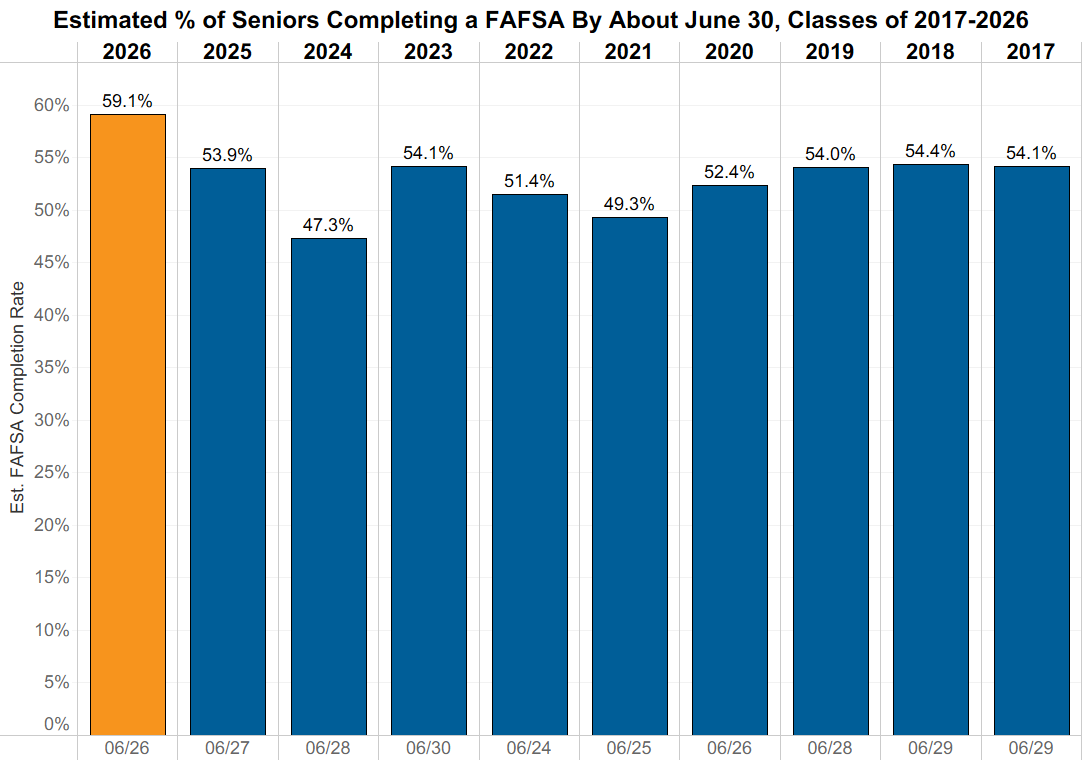
There were 9% more FAFSAs completed by June 30 for the class of 2026 than the class of 2025, an increase of more than 200,000 seniors completing the form.
These figures come from NCAN’s FAFSA Tracker, which is in its 9th year of reporting high school FAFSA completions at the national, state, and local levels. The Tracker’s data comes from the Office of Federal Student Aid, which reports new figures each Friday.
The class of 2026 is particularly remarkable considering it builds significantly on the class of 2025’s 53.8% completion rate through the same date. The class of 2025 was itself a massive increase over the 46% achieved by the class of 2024 during the extremely difficult Better FAFSA rollout year.
Tennessee claimed the highest FAFSA completion rate by a state at 72.7%. Illinois (71.6%), Texas (69.3%), New Jersey (67.5%), and Mississippi (66.3%).
Alaska (20.7%) takes top honors for the largest percentage increase of FAFSAs completed, followed by New Mexico (18.8%), Florida (16.7%), Montana (16.5%), and Arizona (15.6%).

It is clear that universal FAFSA policies have made an significant impact on this cycle’s results.
Nine states have universal FAFSA policies in place that make FAFSA completion a requirement or expectation for graduation. Not only do these policies put upward pressure on the national FAFSA completion rate, but universal FAFSA states also show up at the top of the leaderboard. Three of the top five, six of the top 10, and seven of the top 15 states by percent of seniors completing have these policies on the books.
Zooming out, the results achieved by the class of 2026 represent a more than decade-long project by the college access and attainment field to connect more students with the financial aid that makes education and training after high school more accessible and promotes the postsecondary attainment that helps students, especially first-generation students, students from low-income families, and students of color, to reach the middle class. Postsecondary attainment is critical for our local, state, and national economies so the impacts extend beyond students and families and into communities.

As previously noted, there are a few reasons for the class of 2026’s resounding success to point towards:
- The 2026-27 FAFSA cycle opened not only on time but early on September 24. Following two previous cycles that opened late at various points in December. The importance of giving students and families two extra months to complete the FAFSA cannot be overestimated. As well as providing high school counselors and college access practitioners with more time to help students through the financial aid process. Two months is the equivalent of 20% of the academic year in much of the country; it makes a huge difference to open on time.
- The FAFSA process for most families is speedier, smoother, and simpler this year. The Office of Federal Student Aid (FSA) deserves a lot of credit for not only the fixes in the process but also the improvements it has made. Changes like instant identity verification during the StudentAid.gov account creation process for most users with a Social Security Number is a game changer. Instant verification means students and families aren’t waiting multiple days to get started with the FAFSA process, and it means that college advisors running financial aid nights can help students complete the process all at once, rather than over multiple days. Beyond that, FSA also reduced the number of fields and screens needed to set up the ID and eliminated the challenge questions and have continued mid-cycle to look at process performance to try to eliminate places that trip up users.
- FAFSA, like any activity, has some muscle memory involved. This is the 3rd year under the new process, which means standard operating procedures are in place, there’s more familiarity with the process, and college access professionals and caring adults around the country are better able to assist with FAFSA completion activities.
NCAN will continue to monitor FAFSA completion through the 52nd week of the cycle (we are at week 39 through June 26) and then roll over to the 2027-28 FAFSA from there. Many states see significant continued gains to FAFSA completion over the summer, and we will report on who had the best summer gains around September 1.
In the meantime, the field and our collective partners deserve and demand a huge appreciation for the energy, enthusiasm, persistence, and passion that went into achieving this result for the class of 2026. Exceeding the previous FAFSA record by nearly five percentage points did not happen by accident; congratulations to everyone involved for realizing this success!