By Raymond AlQaisi, Senior Manager of Policy and Advocacy
Reading time: 4 min.
Today, President Biden released his full budget for fiscal year 2023, which includes some of NCAN’s top priorities – robust Pell Grant investment and access to federal student
aid for DACA recipients.
The president’s budget proposal expresses a commitment to double the maximum Pell Grant by 2029 and, if adopted, would significantly increase the maximum award to $8,670 for the 2023-24 award year.
"NCAN applauds President Biden for including a historic-high maximum Pell Grant of $8,670 in his administration’s fiscal year 2023 budget," said Kim Cook, NCAN's CEO. "Strengthening the need-based Pell Grant is one of the best, and best-targeted, ways
to help close equity gaps by race, ethnicity, and income in postsecondary attainment." Cook added: "We urge Congress to help make college more affordable for millions of students by funding the president’s request for a stronger Pell Grant."
NCAN’s goal of #DoublePell is to restore the award’s purchasing power to half the average cost of attendance for a bachelor’s degree at an in-state, public institution. If Congress passes the president’s budget request, raising the maximum Pell Grant
to $8,670, the purchasing power would rise from the current 30% to an estimated 36%.
In addition to strengthening the Pell Grant program, President Biden continues to propose expanding federal student aid access – including Pell Grant eligibility – to Deferred Action for Childhood Arrivals (DACA) recipients, sometimes referred to as DREAMers.
Additional key proposals for NCAN members in the budget request include:
$36.5 billion in Title I funding to support schools that serve students in low-income communities and help address disparities in schools’ resources.
$752 million over the 2021 enacted level to support institutional capacity at Historically Black Colleges and Universities (HBCUs), Tribally Controlled Colleges and Universities (TCCUs), Minority Serving Institutions (MSIs), and community colleges.
$800 million over the 2021 enacted level for the Department of Education’s Office of Federal Student Aid (FSA). The increase will help FSA in its efforts to better serve students and borrowers. The funding is also crucial to ensuring implementation
of the FAFSA Simplification Act and the FUTURE Act for the 2024-25 award year. NCAN has long championed efforts to simplify the FAFSA (Free Application for Federal Student Aid).
A $200 million increase for Federal TRIO Programs that provide services to encourage college access and completion; and a $40 million increase for Gaining Early Awareness and Readiness for Undergraduate Programs (GEAR UP) that assist middle and high
school students in preparing for postsecondary education.
$110 million for a Retention and Completion Grant program, which would provide competitive grants to states and institutions to implement or expand evidence-based reforms that improve student outcomes.
Funding for federal campus-based aid is maintained at previous fiscal year levels in the request. The Federal Supplemental Educational Opportunity Grant (FSEOG) program that provides need-based grant aid to eligible undergraduate students would be
funded at $880 million for the fiscal year, and the Federal Work-Study program that provides grants to participating institutions to spur student employment remains at $1.19 billion.
$1 billion investment to increase the number of school counselors, psychologists, social workers, nurses, and other health professionals in schools.
What Happens Next
For students and their advocates, there is much to celebrate in this budget proposal. However, it is just that, a proposal. Congress will need to act to make some or all of the president’s budget a reality.
Members of Congress must now write and vote on 12 appropriations bills that set the funding amounts for the 2023 federal fiscal year, which begins on Oct. 1, 2022. Once Congress passes those bills, President Biden will need to sign them into law.
As lawmakers discuss funding levels, it’s up to us to keep advocating for increased investment in Pell Grants.
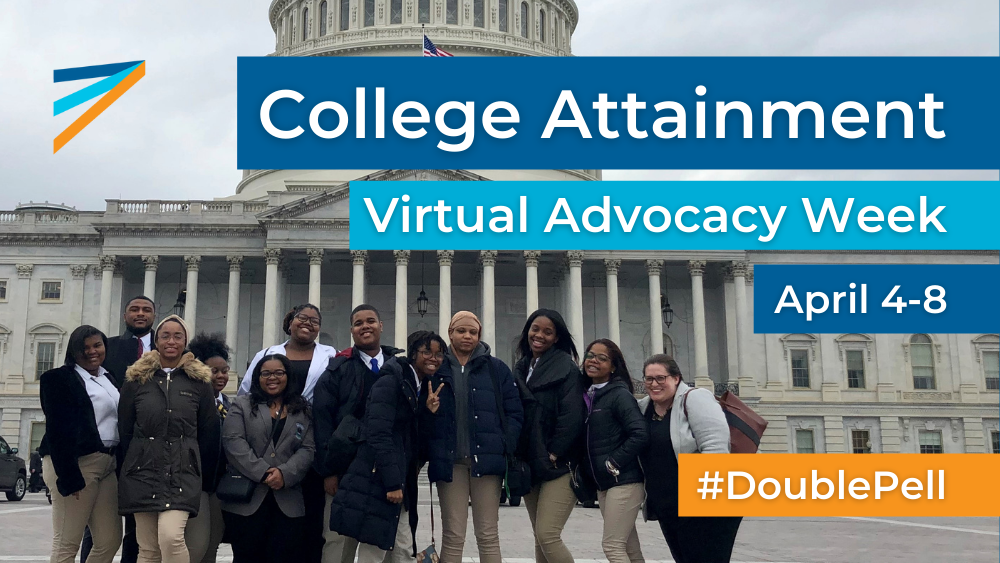
One great way to get involved is to participate in NCAN’s upcoming Virtual Advocacy Week (April 4-8). Members of the college attainment field can provide powerful perspectives that help inform federal
policymakers about the realities of college access and affordability. All NCAN members as well as their students, alumni, and board members are encouraged to participate!
If you have questions about Virtual Advocacy Week, please contact Raymond AlQaisi, NCAN's senior manager of policy and advocacy, at raymond@ncan.org.

 Email to a Friend