By Raymond AlQaisi, Senior Manager of Policy and Advocacy, and Matthew Odom, Communications Manager
Reading time: Three minutes
November 14 marks the
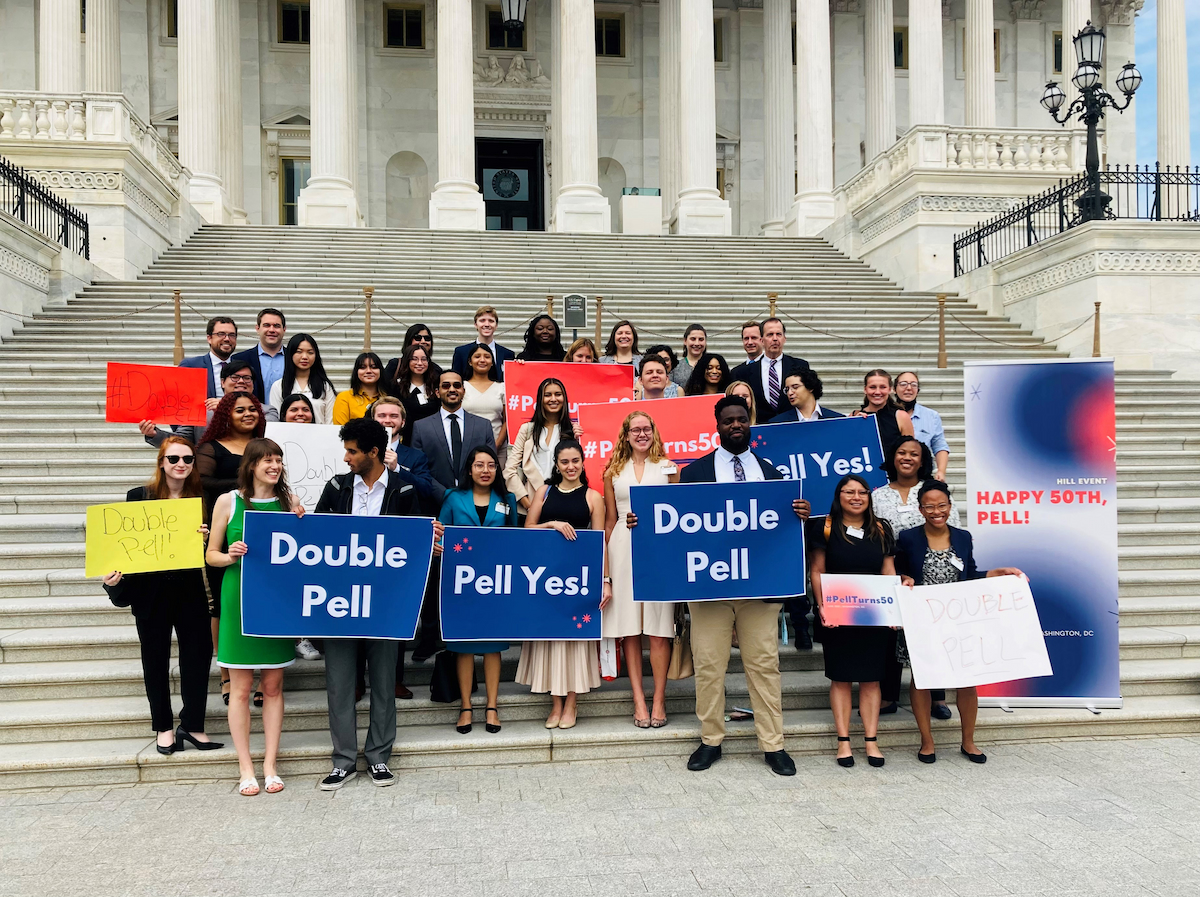
beginning of the National College Attainment Network (NCAN)’s annual #Thankful4Pell #DoublePell advocacy campaign. NCAN members and the students they serve understand how transformational the Pell Grant can be, but it's no secret that it falls short
of making postsecondary education truly affordable for all.
At its peak in the mid-1970s, the Pell Grant could have covered more than 75% of the average cost of attendance at an in-state public four-year university. Today, it’s covers roughly 30%. This decline in purchasing power is highlighted
in NCAN’s research, “The Growing Gap: Public Higher Education’s Declining Affordability for Pell Grant Recipients”, which finds that 24% of public four-year institutions and 40%
of public community colleges were affordable for the average Pell Grant recipient in academic year (AY) 2019-20. Nationally, the average “affordability gap” (i.e., unmet financial need) for the average Pell recipient was $2,627 at public four-year
institutions and $907 at public community colleges in AY 2019-20. Notably, this data captures time before the COVID-19 pandemic, which conceivably only further exacerbated existing equity issues in education.
This year
marked the 50th year anniversary of the Pell Grant program, and coincidentally the biggest increase to the maximum Pell Grant award in over
a decade. However, there’s still much room for improvement when it comes to making higher education more affordable for students. That’s why NCAN and hundreds of organizations and institutions have been calling on Congress to double the maximum Pell
Grant award, which would restore Pell’s purchasing power to 50% of the average cost of attendance at an in-state public four-year university.
What Can You Do?
The week of November 14 - 18, NCAN, organizations, and institutions will be highlighting the importance of the Pell Grant using the hashtag #Thankful4Pell.
Additionally, we’re calling on Congress to raise the Pell Grant by $500 in this year's spending bill and #DoublePell by 2029. NCAN’s Action Center will allow you to easily contact your members of Congress. The text is already drafted and
it only takes a minute to complete this advocacy ask.
Utilize this social media kit to spread these messages and share why the Pell Grant is important
to you and/or the students you serve. Please also watch and share this video to increase awareness.
Why is the Pell Grant Important?
The Pell Grant benefits primarily students from low-income backgrounds. The majority of the approximately seven million recipients annually have family incomes of under $40,000. Additionally, more than half of Black and Indigenous students receive Pell
Grants, as well 48% of Latino and 36% of Native Hawaiian/Pacific Islander students. Doubling the maximum Pell Grant will help address the equity gaps that currently exist in higher education.
College enrollment is 9.4% lower than it was
before the COVID-19 pandemic began. Students at community colleges, those attending public universities, and women have been most acutely impacted. Doubling the Pell Grant will help reverse this decline.
Lastly, the Pell Grant program
is well-established and widespread. The grant is available for a student to use at any Title IV eligible institution in any state. Any increase in funding would have an immediate and vast impact.
Looking to sharpen your advocacy skills? Please check out NCAN’s page of advocacy resources and NCAN’s platform for e-Learning, where there are
two courses on policy and advocacy for college success professionals.

 Email to a Friend