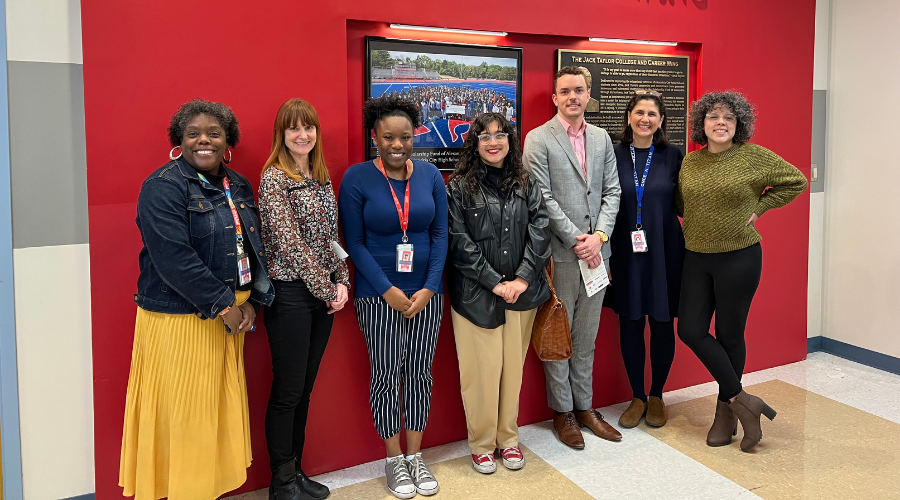
A few weeks ago, my colleague Caroline Doglio and I took a field trip to a place not many think of when the term “field trip” comes to mind – a public school. On January 9, we visited
National College Attainment Network (NCAN) founding member the Scholarship Fund of Alexandria (SFA), in Alexandria, VA, to learn more about the work they do, students they serve, and
their efforts to encourage Free Application for Federal Student Aid (FAFSA) completion.
SFA is unique in that their offices are located within Alexandria City High School (ACHS), the city’s only public secondary school. This allows for increased interaction with the students they serve as well as collaboration with school administrators.
ACHS is huge, both in terms of size and racial and ethnic diversity. As of March 2022, the school enrolled 4,402 students, the largest in the state. Demographics-wise, the student body was 41% Latino/a, 26% Black, 25% White, and 6%
Asian American.
Some of you might know ACHS by its former name: T.C. Williams High School. The school is featured in the 2000 hit Disney film Remember the Titans, which chronicles the newly-integrated football team’s journey to winning the 1971 state championship
title.
I recently sat down with SFA's Director of College Advising Christine Miller to discuss their efforts to increase FAFSA completion, as well as the challenges the face and solutions they’ve implemented.
The following conversation has been lightly edited for clarity.
NCAN: What are some challenges your organization faces with regards to the FAFSA and encouraging completion?
SFA: The biggest challenge is the size of the class. With 1,110 seniors, outreach is difficult due to logistics. We work with school-based personnel and community partners to ensure that we share information with students and families
in many different ways. We aim to ensure that every student gets the same information and support.
Some of our students are hesitant or reluctant to share personal information, sometimes due to their documentation status or that of their families. There is also a lack of information and understanding of the benefits of completing the FAFSA.
NCAN: What communication methods and strategies do you use to encourage the students you serve to complete the FAFSA?
SFA: Relationships! Cultivating a rapport with students and partnerships with counselors and community stakeholders is vital. This is primarily accomplished through one-on-one meetings. As we build trust with students and families, they
see us as subject matter experts. When we promote FAFSA completion, students believe that it’s important.
In terms of specific channels and tools, we use Signal Vine, a text messaging platform, to connect with students who have both registered for
FAFSA support and those who have not. We push out a variety of announcements using our school’s Parent Teacher Student Association newsletter, Canvas, as well as our own monthly newsletter.
We’re also active on social media, but sometimes good old-fashioned fliers posted around the school is just as effective.
NCAN: How do you encourage FAFSA completion among students who might be hesitant to provide Federal Student Aid (FSA) with their personal information (for example, DREAMers and DACA recipients)?
SFA: Within our offices, we have the ability to meet with students in a confidential setting to ensure their personal information is kept safe. If FAFSA verification is required, we support our students through that process. We collaborate
with the Alexandria International Academy, a specialized school for English language learners, as well as school-based support staff to provide students with additional support and resources.
Outside of school, SFA hosts workshops and one-on-one meetings with students and families to help them complete the FAFSA. We also partner with external agencies and organizations serving their communities and go to them, rather than ask them to come
to us, so we can meet them in a space that feels more comfortable and secure.
NCAN: The student population you serve is incredibly diverse. How do you ensure effective communication with them (and their parents), especially when there is a language barrier?
SFA: We use a lot of the same tactics used with students who are hesitant to provide FSA with their personal information. We partner with the Alexandria International Academy as well as Alexandria City Public Schools to provide resources
in different languages and translation services when needed. We also partner with community organizations and affinity groups and go to where the students and their parents are, rather than asking them to come to us.
NCAN: SFA’s small staff serves a student population of over 4,000. What strategies have you implemented to ensure you reach the students most in-need?
SFA: As a small organization, we aim to work smarter, not harder. Social media is definitely a great way to amplify our voice and messages. The partnerships we’ve built with community organizations and academic partners have allowed us to add extra capacity
that we otherwise wouldn’t have. When hosting large workshops or events, we rely on volunteers from the school and community.
We’re fortunate to have a community that cares about or student population, whether they’re helping at FAFSA-related events, reading applications, or helping SFA fundraise for scholarships.
NCAN: A lot of scholarship programs struggle to maintain contact with their alumni, something that SFA does well. How do you maintain contact and keep them engaged
SFA: Texting (via Signal Vine) is one of the most useful resources in terms of keeping in touch with alumni. Through that
platform, we’re able to send out mass texts as well as individual messages to both our current students and alumni. These texts go to all alumni, not just those who were awarded a scholarship from SFA. Many of our former students also receive our
monthly newsletter as well, unless the opt-out.
Due to the fact that most of the scholarships we award are renewable, we’re able to maintain contact with the alumni who do renew. Our messaging to our former students is that we’re always here to support them and be a resource, even after they graduate
from high school.
For those who were awarded SFA scholarships, we typically host an alumni luncheon to allow recent graduates to connect and reflect upon their transition to college. This is typically offered in early January, when most college students are home for winter
break.
Thank you to the staff at SFA for hosting NCAN at their offices and for taking the time to chat with us about their FAFSA completion efforts.

 Email to a Friend