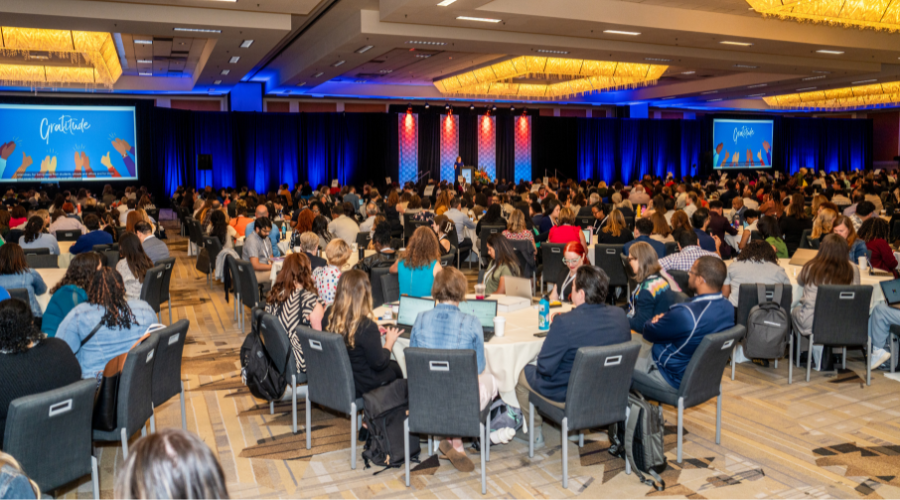
While trying to recover from college enrollment dips in 2020, and facing similar rates after last academic year’s delayed Free Application for Federal Student Aid (FAFSA), we know persistence and completion are crucial to student success and socioeconomic
mobility. Here’s a roundup of some of the exciting sessions in our postsecondary success track at our 2024 National College Attainment Network (NCAN) National Conference!
“Empowering Rural Futures: Innovative Approaches to Postsecondary Advising and Student Success,” presented by OneGoal
Fun fact: did you know the US Census Bureau classifies 97% of America as rural, but only 19% of the population lives in what
is deemed to be rural areas? As this session points out, rural students deserve just as much support as students living in urban areas.
OneGoal presenters Dr. Kayla Ritter Rickels and Renee Vai stressed the importance of looking toward the future while still honoring the past. “How do we respect the local cultural narratives but in
a way that reflects the opportunities that provide the most economic benefits to students? I’m from a small Kentucky coal town and the narrative was coal or college, one or the other. You don’t want to disrespect the tradition and effect coal has
had on this town, but we know coal is not the main economic opportunity in that town anymore,” Ritter Rickels said.
Just as in urban areas, a college going culture is going to require everyone to pitch in and inspire students. Ritter Rickels expressed the need to de-silo the college going process. “We don’t want it to only live with our counselors. Let’s have history
teachers explain to students the possible career opportunities in history, etc. It’s one more adult showing a student their options,” she said.
In one of their case studies, Vai noted that creativity can lead to building stronger intercommunity ties. “Get creative with who exactly is your local college access and attainment partner. Tipton County, Tennessee Schools approached their local car
dealer. They agreed to be a partner because their whole business relies on the next generation of folks staying in town and having the means to buy cars. In a roundabout way, they have an interest in the college enrollment of students in town,” she
said.
In most rural areas, folks have already figured out that tapping into the largest regional employer is a great idea for partnerships, but Vai urged attendees to look deeper, saying, “If you have a hospital system nearby, there’s typically not just medicine
jobs. There are engineering jobs, food service jobs, philanthropy roles, on and on.”
“How to Be a Relentless Ally: Supporting Black and Brown Students Post-Affirmative Action,” presented by Bottom Line
Last summer, when the US Supreme Court (SCOTUS) struck down the use of race in college admissions, it left a lot
of us wondering how to still help students secure their spot, and how to best support students of color during a disheartening time.
Bottom Line’s own Michelle Barton and Michael LeeYow shared their findings on what makes a relentless ally. “What are implicit messages our students are receiving when detrimental circumstances,
like the SCOTUS decision on race-based admission or FAFSA delays, arise? It’s important that we follow that first step of listening, and take note of these things before we respond to them, so that our response stays directly student centered,” Barton
said.
Over the past year, we’ve all been finding ways to help students express their capabilities while not focusing on the traumatic aspects of their lives. With many students looking to the admissions essay to display their various identities, Barton once
again emphasized creativity. “Be thoughtful about who you ask for recommendation letters. Ask someone who can really speak to a student’s resilience so that the student doesn’t need to use their one platform to dwell on that. Every student doesn’t
feel it’s important, and they shouldn’t have to use their essay space to trauma dump, or even spin their identity into a positive,” she said.
When asked what they could start, stop and keep doing to be relentless allies, one audience member mentioned the University of Nebraska at Omaha is no longer charging an application fee for its undergraduate programs. Another attendee said they stopped devaluing HBCUs and instead created more partnerships between their districts and the state’s HBCUs admissions offices.
“Leveraging GenAI to Ethically and Responsibly Advance First-Gen Access and Success in College and Beyond,” presented by Beyond 12 and Get Schooled
With the rise of the use of generative artificial intelligence (GenAI) in higher education, Beyond 12’s CEO Alexandra Bernadotte and Get Schooled’s
Executive Director John Branam joined forces to share how to use GenAI in ethical, sustainable ways to build capacity and better serve students.
Get Schooled AI tool, Interview Coach, walks students through the job interview process, giving them real time feedback on what they did well and where they could improve. “For quality
control in terms of building these tools, our original AI bot was giving us responses as if our target audience was a 28-year-old white man. We had to work that out of it to get it to talk to our actual audience of 16–20-year-old Black and Brown kids,”
Branam said.
Both Bernadotte and Branam stressed the importance of starting with the human aspect and using AI to augment. Beyond 12’s tool, MyCoach, is a conversational empathetic coach to help automate the questions
Beyond 12 coaches get that don’t require a human so that human coaches can tackle for more complex situations. Along with teaching their tool to operate Socratically, Bernadotte said implementing culturally competent curriculum into their AI Coach
was crucial, so it feels more authentic when students have those deeper self-doubt outreach moments. There’s also a responsibility to eliminate bias, and this helps serve that goal.
When looking to build your own AI powered tools, Branam and Bernadotte encouraged attendees to keep students at the center. “As we’re thinking about the next evolution of our AI tools, 1,100 students completed a 35-question survey. We don’t want to build
these tools in isolation; we’re building them to work within our system to reach our mission, vision and goals,” Branam said.
Bernadotte highlighted the value in 360 feedback. “‘Are students using it’ is one measure. How are they feeling about using the tool? We’re also surveying our coaches and getting their feedback. Are students who are using the tool persisting and graduating?
Can we demonstrate that their use of the tool was a factor in them persisting and graduating? How do we make a case for causation? The goals haven’t changed, this is just one more tool to help us get there.”
Of course, Bernadotte addressed the elephant in the room and acknowledged students reluctance around AI. “There’s a thought, with Black students specifically, that they don’t want to touch AI because institutions are taking a stance that AI is just a
tool used to cheat on assignments. Black students want the plausible deniability to say, ‘I didn’t use AI.’ But the industry is expecting graduates to know how to use these tools, so we have to change the narrative.”
We hope you enjoyed these snapshots of our postsecondary success track at our 2024 NCAN National Conference! Registrants can download the presentation slides and additional resources for these
sessions in the conference app.

 Email to a Friend