By Bill DeBaun, Senior Director, Data and Strategic Initiatives
Reading time: Six minutes
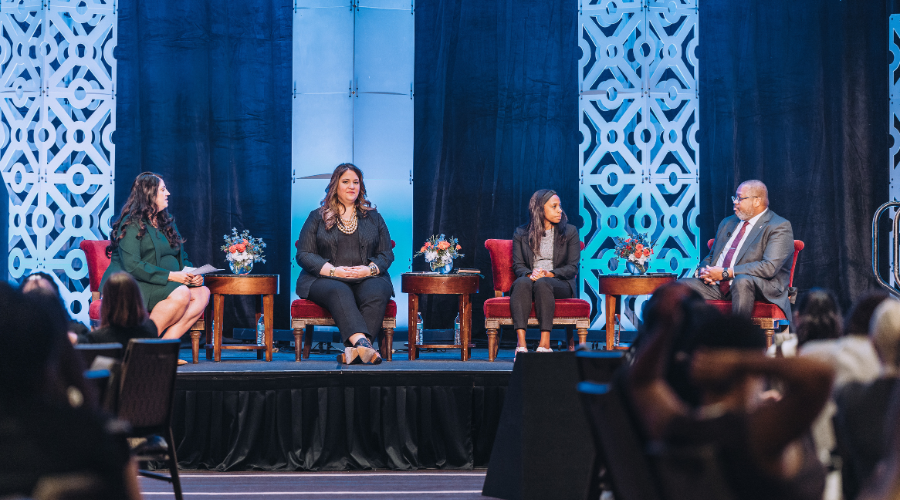
“If you’re scared, you can’t teach and you can’t mentor, and it’s the only reason we’re here. Do your job and do the thing you’re trained to do.” This was the counsel of Dr. Xavier Cole, President of Loyola University of New Orleans, during the “Meeting
the Moment” plenary session at the National College Attainment Network's (NCAN) 2025 National Conference.
It’s a fraught time for the college access and attainment field and higher education in general, but NCAN and our members across the country are, as the title suggests, working to meet the moment.
Cole was joined by Skye Perryman, President and CEO of Democracy Forward, a national legal organization that advances democracy and social progress through litigation, policy and public education, and regulatory
engagement, and Chibuzo Ezeigbo, Senior Program Officer for the Education and Economic Mobility Program at the Joyce Foundation. The panel was moderated by Catalina Cifuentes, Executive Director of College and
Career Readiness, Riverside County Office of Education, Chair of the California Student Aid Commission, and President of the NCAN Board of Directors.
Cifuentes opened by noting that in recent months, the Trump administration has eliminated targeted support for students of color, slashed education research funding, and proposed eliminating federal programs like GEAR UP, TRIO, and even the US Department
of Education. In the face of this, “NCAN members are leading with passion and persistence in the things we do.” She added, “The words we say matter to students – if not us than who?”
Perryman, whose organization represents NCAN in its lawsuit challenging funding cuts to AmeriCorps, noted that she was “so proud” of NCAN as a plaintiff in a case that helped secure the restoration of AmeriCorps funding. “You did that,” Perryman extolled,
“No member of Congress did that. We did that bringing the case and pushing the case – it’s a win nobody can take away because the funds have been pushed out.”
More broadly, Perryman emphasized, “The cost of inaction is so much more than the cost of doing your thing and pursuing your fight. There isn’t a benefit to keeping your head down and hoping you’re going to slide off the radar. You’re involved in educating
people and that’s a threat to people who don’t want a broad civil society and freedom.”
Ezeigbo noted, “Knowledge is power, especially information that’s accessible, powerful, and relevant.” It’s why the Joyce Foundation established a network for state policy advocates to get briefings from a law firm about what the executive orders mean
about what might change at the state level. “It’s about getting that information and translating and forming next steps,” Ezeigbo explained. Other philanthropies have formed similar networks. “It’s one place where philanthropy has really been able
to help support this effort and help grantees keep track of what has been going on.”
Philanthropy, Ezeigbo continued, “moves very, very slowly.” But recently she’s “been really excited to work with other foundations who have acted very quickly and provided last minute funding or lots of different kinds of flexibility to meet the moment.”
Notably, the philanthropic community has been flexible with grantees who are doing their regular work. For example, the Joyce Foundation has converted project funding to general operating funding, extended deadlines, and removed reporting requirements.
“Time and time again, I hear our CEO say we aren’t backing down on our mission of advancing racial equity and expanding economic mobility,” said Ezeigbo. “It helps to provide cover for organizations who don’t have the leeway that philanthropy does.”
Perryman offered some honest, and ominous, insight and advice to attendees, which is worth quoting at length:
The thing I want everyone to walk away from this room is the paradigm has shifted in this country. It’s hard for us to hear….The rules of the game and engagement are different when confronting that. The courage to say, ‘We are going to do what we need
to do to support our programs, or we’re going to go to court’ – we are not seeing those strategies put institutions in more danger. Strength and courage are not more of a liability for institutions. It used to be that way, but it’s not where
we are. We have to help ourselves and our advisors live with that reality. Being able to stand in your power is more of an asset than a liability. These are different muscles that we’ve got to use and work.
Cole touched on this idea of strength and courage in his remarks. “The one thing you have that can’t be given away is your integrity. If your personal integrity is being corrupted, you then have to say no, and then stand by whatever decision I have made.
If I can stand by a decision, I’m good with it, whether it was right, wrong, hurt, helped because that’s why I was selected to lead this university.”
“There are things I believe and things my university espouses and believes,” he explained. “I have to hold both in balance. What should I fight and what should my university and those two things shouldn’t be conflated.” He criticized institutions who
have complied in advance and warned that doing so “leaves you open to it happening again in the future.”
At the conclusion of the plenary, the panelists offered their advice to the audience and the field.
Perryman urged, “We have to help support organizations and their leaders to get a new mindset….The older rules of engagement aren’t working with this administration….Institutions that are able to guard integrity, protect strategies, be principled, and
require [the administration] to work for it are the ones who are able to achieve the results that they have wanted…It’s how we restored AmeriCorps and $6 billion in funding. None of that came through complying in advance or capitulating. We are going
to respond and force these issues.”
Ezeigbo, for her part, counseled organizations, “Consider legal risk and mission risk. Everyone here chose the profession you did for a reason. We’re here to support students. Mission risk is something that can’t be discounted in this moment. It’s admittedly
a scary time. I can’t think of any type of organization in the nonprofit sector that hasn’t felt under attack. This isn’t the moment to capitulate. What might you be giving up mission wise by potentially over-indexing on the legal risk? You have to
keep those two things in balance. This isn’t just a fight for the lawyers or those who work in policy/advocacy this is for those who work in direct service, districts, schools we have to form coalitions to work through this.”
Cole, lastly, advised: “Do not allow for yourself to be isolated. We are all part of networks of like people and organizations. Don’t feel compelled to respond to something in the moment. Drop back, game plan it, there’s strength in numbers…You do this
together. That strength in numbers will have a larger, stronger voice and impact. Slow down, don’t feel compelled to jump when someone asks you to jump, ask why they want you to jump.”
The threats to the field and the broader higher education sector are real. The fear of students, families, and other education stakeholders is real. But so too is the power of this network. “Just you being here in the room together,” Cole said, “links
us as a community the way we should’ve been before there was a crisis.”
The panel emphasized that this is not the time to retreat. It is the time to push forward and use every tool available: litigation, advocacy, organizing, teaching, mentoring. To resist isolation, to guard integrity, and to stay relentlessly focused on
students.
NCAN members are already meeting the moment. The challenge now is to keep fighting.

 Email to a Friend