By Alessandra Cipriani-Detres, Senior Associate, Strategic Initiatives
Reading time: Three minutes
In November 2025, Pennsylvania Governor Josh Shapiro (D) brought together Democrats and Republicans to pass the fiscal year (FY) 2025-26 state budget. Included in the
budget is language requiring high school seniors to complete the Free Application for Federal Student Aid (FAFSA) as a graduation requirement.
What's In the Policy?
As with all universal FAFSA polices, students and/or their parents or guardians may opt out of the requirement. The Pennsylvania Department of Education and Pennsylvania Higher Education Assistance Agency (PHEAA) will work together to develop the opt-out
form. PHEAA will also be responsible for providing schools with information about who has completed a FAFSA, which will allow counselors to follow up with and support students who have not.
If a school determines that a student has neither submitted the FAFSA nor completed an opt-out form, the school must make a concerted effort to contact the student’s parent or guardian and provide them with information about the purpose and benefits of
completing the form. Once this occurs, the school may exempt the student from the requirement.
While Pennsylvania’s policy is an unfunded mandate, efforts are underway to rally attention and investment to support local education agencies in implementation.
Will it Work? Why Aren't More States Following Suit?
As of December 12, 2025, about 30% of Pennsylvania’s high school class of 2026 completed a FAFSA. This ranks the Commonwealth 24th among all 50 states and the District of Columbia.
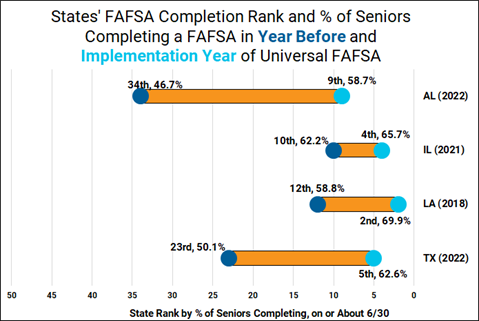
The National College Attainment Network (NCAN) typically finds that when a state implements a universal FAFSA policy, both FAFSA completion rates and state rankings increase. States with relatively
low FAFSA completion rates pre-implementation see the most significant gains, while states with already medium-to-high completion rates experience more modest improvements.
Beyond FAFSA completion, research on the impact of universal FAFSA policies has surfaced important findings related to postsecondary enrollment. These insights from The Century Foundation (TCF) are particularly relevant for states considering adoption of the policy:
Across Louisiana, Illinois, Alabama, Texas, and California (states that implemented a universal FAFSA policy prior to the class of 2024), the number of Pell Grant recipients increased by approximately 27,500 new students just one year after policy
implementation.
In terms of undergraduate enrollment, Louisiana, Illinois, and California exceeded national enrollment trends by 3.5 percentage points, 3.8 percentage points, and 5.1 percentage points, respectively.
Although FAFSA completion rates are often (but not always) correlated with community income, TCF further found that the gap between high- and low-income districts narrowed after policy implementation or flipped in favor of low-income districts in
five of the seven states studied.
Despite growing evidence of the effects of universal FAFSA policies, momentum at the state level has slowed. For example, four states implemented universal FAFSA policies for the 2024-25 school year. That same year, however, Louisiana and New Hampshire
became the first states to repeal their policies.
The FAFSA remains one of the most powerful tools for expanding access to postsecondary education, unlocking billions of dollars each
year in federal, state, and institutional aid that too often goes unused. Universal FAFSA policies help normalize completion, reduce information gaps, and ensure that students are not leaving financial aid on the table simply because of barriers to
awareness or access. For states, higher FAFSA completion rates often translate into an increased uptake of federal dollars and stronger postsecondary enrollment outcomes. As Pennsylvania joins a small but mighty group of states to adopt a universal
FAFSA policy, its implementation and outcomes will offer valuable lessons for how policy, practice, and collaboration can better support students in their postsecondary pathways after high school.

 Email to a Friend