By Bill DeBaun, Senior Director of Data and Strategic Initiatives
Reading time: Two minutes
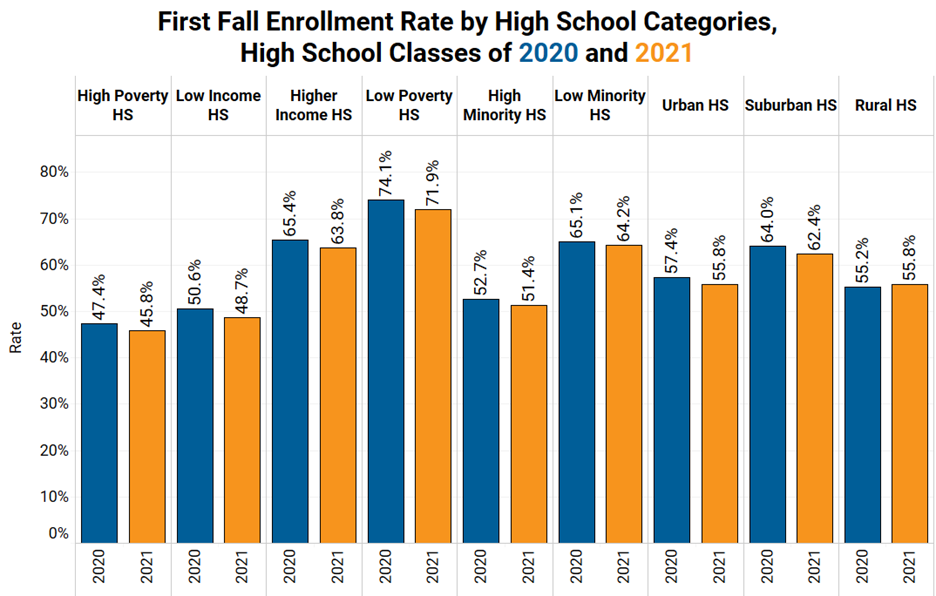
High school seniors from the class of 2021 experienced substantial first fall enrollment declines compared to the class of 2020, according to a new release from the National Student Clearinghouse Research Center (NSCRC) High School Benchmarks report series. The data show larger enrollment declines for high schools serving larger populations of students from low-income backgrounds, students of color,
and first-generation students and offer yet another confirmation of the COVID-19 pandemic’s impact on students.
Districts and high schools can access similar data for their own students, for an annual fee, via the NSC's StudentTracker service. Have questions about the StudentTracker plan that's right for you? Reach out to Bill DeBaun, Senior Director of Data and Strategic Initiatives, at debaunb@ncan.org.
"NCAN and our members suspected this bad news was coming, but seeing it on the bar charts is even more devastating," said National
College Attainment Network (NCAN) CEO Kim Cook. "The students served by NCAN and our members every day continue to face barriers for postsecondary success. Given what we know about immediate enrollment and eventual completion, we have an uphill battle
ahead of us. There's a real possibility that attainment for the classes of 2020 and 2021 will never recover from these enrollment gaps."
High poverty high schools saw their first fall enrollment rate decline to 45.8% (from 47.4% for the
class of 2020). Schools with a substantial number of students from low-income backgrounds declined from 50.6% to 48.7%. Schools with substantial BIPOC student populations declined from 52.7% to 51.4%. The chart below compares the first fall enrollment
rates of the classes of 2020 and 2021 by high school category.
The NSCRC categorizes high schools’ income levels in four ways, according to the proportion
of students participating in free or reduced-price lunch programs. "High poverty" schools have 75% or more of their students participating in their programs; "low income" schools have 50% or greater participating. Conversely, "higher income" schools
have less than 50% FRPL participants, and "low poverty" schools have less than 25%. The NSCRC also categorizes high schools as “high minority” if they have 40% or greater Black or Latino/x students, while “low minority” schools have less than 40%.
“These disproportionate outcomes are solidifying an even larger and potentially permanent difference in postsecondary enrollment trends for students of color and students from low-income families. College-going is a habit, and, nationally,
we’re breaking it,” said Bill DeBaun, NCAN's Senior Director of Data and Strategic Initiatives.
The new report also covers the first-year persistence rates from the high school class of 2019 and the six-year completion outcomes from the
class of 2015. NCAN will cover these results separately because for now the attention needs to be on the relatively more pressing news about these declines.
These results also strengthen the association between FAFSA completion and first-fall
enrollment rates. NCAN tracks high school seniors’ FAFSA completion outcomes diligently via our FAFSA Tracker. The Tracker record a 4.8% decline year-over-year in completions
by June 30 for the class of 2021. This followed a 3.7% decline for the class of 2020.
NCAN will continue to explore these data and may update this post to provide further analysis.

 Email to a Friend