By Patrick Rodriguez, Co-Executive Director of the Georgia Coalition for Higher Education in Prison and Catherine Brown, Senior Director, Policy and Advocacy
Reading time: Six minutes
Over the last nine months, with the support of Patrick Rodriguez (an author of this blog) and Sheila Meiman of the National Association of Student Financial Aid Administrators (NASFAA), the National
College Attainment Network (NCAN) has been facilitating a fellowship program aimed at developing a cohort of college access and success
programs to serve justice-impacted learners. The eight participating fellows have been working to develop a plan for growing their organization’s impact to support students who are incarcerated and/or those who were enrolled in a prison education
program and are reentering free society. Fellows have conducted a needs analysis and created an ecosystem map of their communities. They are now in the process of developing a guidebook and strategy and cultivating partners to allow them to more deeply
engaging in this work of supporting this population in attaining a college degree.
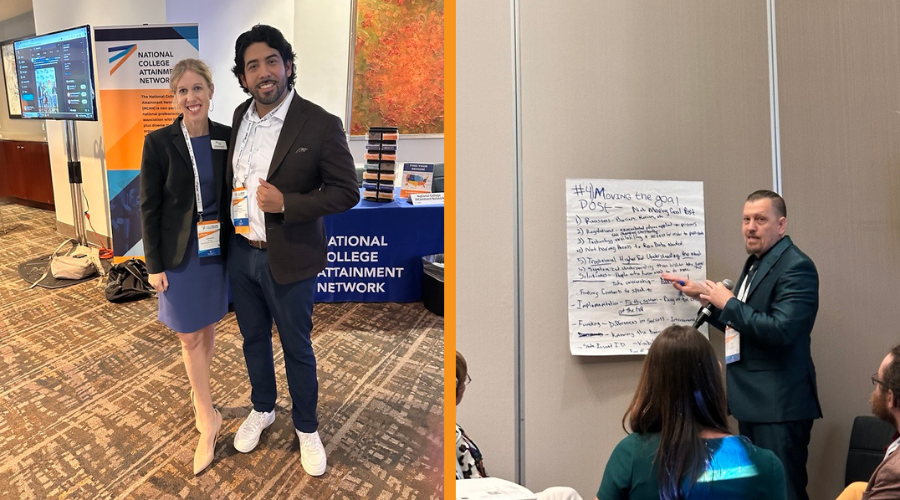
As part of this fellowship, NCAN supported the fellows in attending the organization’s 2024 National Conference in Anaheim, CA from
September 16-18. Not only did the fellows network with one another, share meals and get to know each other personally, they also participated in an interactive session, "Interrogating Complex Barriers in Higher Education in Prison and Traditional
Higher Education Settings", focused on systemic obstacles within both prison and traditional college pathways.
With the restoration of Pell Grant-eligibility, higher education in prison has gained significant attention from colleges and universities seeking to provide more inclusive and equitable education opportunities. However, as this session revealed, multiple
structural barriers still threaten to derail progress in connecting system-impacted individuals to postsecondary credentials. College access and success programs can be instrumental in addressing these challenges.
The session was led by William Freeman, Manager of the Education Trust’s Higher Education Justice Initiative, and Alexa Garza, Texas Policy Analyst, also of the Education Trust. The speakers provided
an overview and introduction of the Justice Policy Fellowship program and then the fellows, Roderick Jackson, Barbi Brown, Mirvais “Mir” Aminy, Adam Lay, Arianna Mellinger, and Andre Sorell, introduced themselves. The Justice Fellows will be conducting
a survey on higher education in prison programs in seven states to identify barriers for individuals seeking post-secondary education that have been impacted by the criminal legal system. Afterwards, the session was divided into the following groups:
gatekeeping, ontological exclusions, and erasures of formerly incarcerated people, basic needs, and the moving of goal posts. Here is a quick description of each portion:
Gatekeeping: Gatekeeping refers to how access to information, opportunities, and resources is tightly controlled - particularly within prison systems. In the context of higher education, gatekeepers such as prison administrators,
educators, or policymakers can either facilitate or hinder access to academic programs. To address these challenges, the group suggested several solutions starting with the need for checks and balances within educational systems to ensure equitable
access to resources. Participants emphasized the importance of trusting feedback from individuals directly impacted by incarceration, as they often possess first-hand knowledge of the most effective solutions. A primary recommendation was improving
communication around available programs and resources. Facilitators suggested sending letters to returning citizens with clear information on educational opportunities, while also advocating for state-level policies to improve transparency and
resource distribution. The group also encouraged education providers to ask the right questions, listen to incarcerated and formerly incarcerated individuals, and develop intentional strategies to overcome gatekeeping practices that often remain
invisible but deeply entrenched.
Ontological Exclusion and Erasure of Formerly Incarcerated Individuals: Ontological exclusion refers to the way society erases the identities and contributions of marginalized groups, particularly formerly incarcerated individuals.
In higher education and employment, this problem often manifests as implicit bias during the hiring process and institutional barriers to credential recognition. Participants advocated for reevaluating hiring practices to challenge entrenched
perceptions that limit opportunities for formerly incarcerated individuals. They also stressed the importance of partnerships between institutions to improve access to credit recognition and financial aid, which are critical for students transitioning
out of prison and into traditional higher education. The group also called for greater awareness and shifts in how institutions collect and use data, emphasizing the need for data-tracking infrastructure that avoids further stigmatization of impacted
individuals. This aligns with broader diversity, inclusion, and accessibility initiatives that are gaining traction across higher education.
Addressing Basic Needs: A third key theme centered on basic needs, which are often overlooked yet essential for educational success. Formerly incarcerated individuals frequently face challenges related to housing, transportation,
digital literacy, and food insecurity, all of which can derail efforts to re-enter higher education. The group identified solutions such as building partnerships between housing providers and educational institutions to create stable living environments
for students. They also emphasized the need for improved access to digital literacy programs, particularly as incarcerated individuals often face technological barriers upon release, including limited experience with current digital tools. Participants
also discussed the need for assistance in navigating government benefits applications and securing state-issued IDs, both of which are critical to ensuring stability and access to resources. Legal support for formerly incarcerated students, especially
in relation to legal fees and post-incarceration compliance, was also highlighted as an area in need of greater attention.
Moving Goalposts: This topic refers to instances where regulations, expectations, and processes change frequently, making it harder for incarcerated and formerly incarcerated individuals to achieve success. Participants noted that
changing regulations - especially within prison systems - create significant obstacles, exacerbated by racial biases and limited access to technology. The discussion stressed the importance of advocacy and taking ownership of these issues, particularly
in working with decision-makers to implement meaningful changes. Participants advocated for clear, transparent data systems and partnerships with individuals and organizations willing to push for more external oversight of the systems responsible
for these barriers. By identifying these constantly shifting barriers, the session highlighted the need for targeted advocacy efforts that address both systemic racism and practical issues like technology access and policy change.
The Path Forward: Practical Solutions and Advocacy
With the reinstatement of Pell Grants for incarcerated students in July 2023, higher education in prison is now positioned as a critical area of growth in the college access field. NCAN’s fellows will lead the way by producing tools and resources and
serving as technical assistance providers for college access and success programs looking to expand into this area of work. As the session made clear though, the road ahead is filled with challenges that demand strategic solutions and partnerships.
Higher education has the potential to transform lives, particularly for those impacted by the criminal justice system. Yet, without addressing the barriers that persist, many individuals will continue to be excluded from opportunities that could change
their future. This session provided not just an analysis of these barriers, but also a roadmap for collective action, ensuring that higher education can truly be a pathway for all.

 Email to a Friend