On the heels of a challenging year focused on pandemic recovery, 2022-23 delivered more unexpected turns: persistent learning loss, the fight to turn the tide on declining postsecondary enrollment, delay in implementing the new Better Free Application
for Federal Student Aid (FAFSA), and the US Supreme Court decision ending the consideration of race in college admissions. These developments continued to significantly redefine the work of postsecondary access and success and the environment in which
we operate.
In particular, the Supreme Court’s decision left many college access and success practitioners devastated that diversity in higher education and access for all are not valued. The National College Attainment Network (NCAN) affirms our commitment to racial
equity and will continue to support our members with guidance about adapting to changes in the admissions process, emphasizing proven and lawful practices that support diversity in higher education. We will provide brave spaces to have those conversations
and thought leadership to say loud and strong that our students belong.
Our mission and determination remain undeterred and inspire us to work harder to meet the moment. I hope this year in review drives home the passion and hard work of our NCAN staff and NCAN member programs as we strive to be as innovative and resilient
as the students we serve.
Building Field Capacity
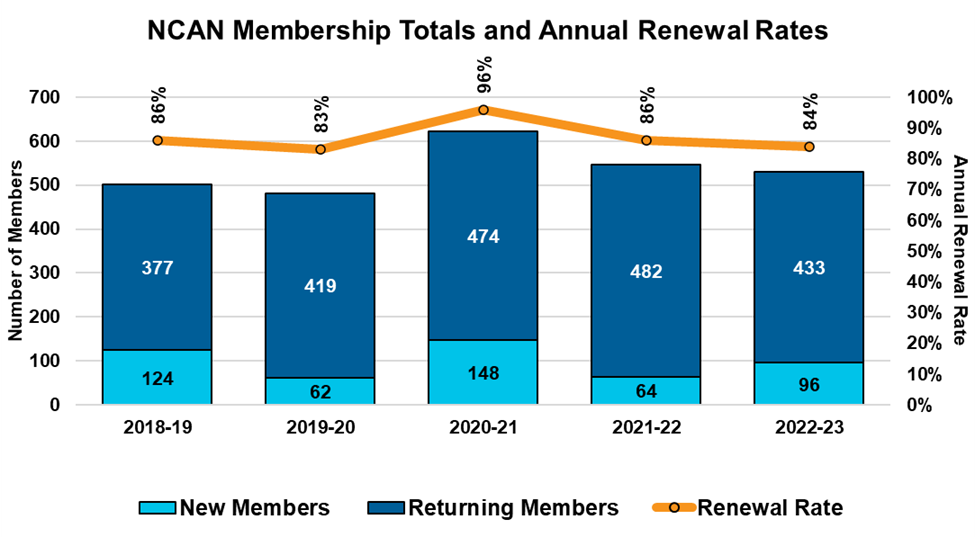
NCAN’s membership remained strong during 2022-23 with more than 500 member organizations, an 84% member renewal rate, and notably high new member growth rate (50% higher than 2021-22, see chart below). Total membership
is not quite as high as during the prior two years, but that is mostly due to the expiration of grants that allowed us to provide free memberships during the COVID-19 emergency.
In NCAN’s 2022 member survey, 85% of those responding said that NCAN helps them do their jobs better. Here are a few comments from the survey:
I not only renewed for the fourth time, I convinced other state local college access network coordinators to join NCAN and many have followed through, citing all that they have learned from my references to what I've learned through engagement with NCAN.
NCAN’s resources are valuable for staying up to date and learning from peers about best practices in the field; staying informed and being able to ask questions about current issues and events impacting our sector; making it easy to sign on to important policy advocacy efforts; and networking with peers at conferences.
I am a new member since late 2021 but a longtime follower of NCAN. I am very glad that I joined, appreciate all the resources offered by NCAN - most notably the policy and advocacy work which is why I joined - and looking forward to attending my first NCAN conference this fall as a presenter.
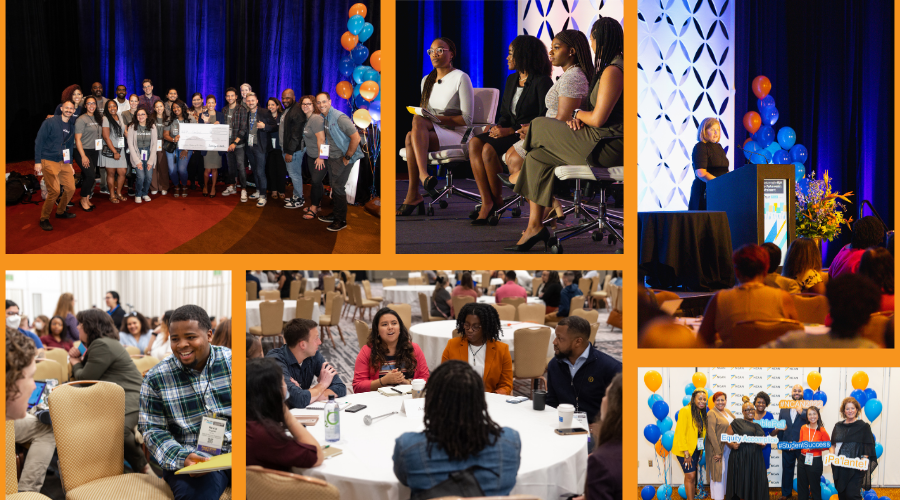
The return to an in-person national conference after two years of virtual events was the hands down NCAN staff highlight of the year and achieved our highest in-person registration ever, 1,206 individuals (see chart below). Participants
were highly engaged and visibly happy to be back together in person.
The NCAN conference normally gets high ratings from participants, but in 2022, 95% of attendees responding to the post-event survey reported that they were satisfied or very satisfied with the conference. Comments included:
I appreciated the incredible networking opportunities and many concrete ideas to apply.
There was great energy!
The plenary speakers were outstanding!
The conference received strong sponsorship support with leading investments from Equitable as the presenting sponsor and the Trellis Foundation to support attendance by the Texas college access and success field.
Plenary speakers included Office of Federal Student Aid COO Richard Cordray, noted author
and college president Beverly Tatum, a panel of college students discussing college unaffordability, and three NCAN member CEOs addressing
the topic, “Is there a right to postsecondary attainment?”
NCAN also stepped up our programming to address issues of diversity and inclusion including our first conference use of affinity
groups and workshop topics such as, “Eradicate Anti-Black Policies & Procedures,” “Lessons from the Field: Supporting Leaders of Color,” and “Keepin’ It Real: Perspectives, Insights and Frank Talk with Black Male Executives.” A pre-conference session
led by The Steve Fund focused on how race-related stressors like microaggressions and internalized oppression impact our and our students’ mental health. We also learned that compassion fatigue
is very real and can take a significant toll on white and BIPOC practitioners alike.
Early in 2023, NCAN reconceived our annual virtual Spring Training as a full week of webinars held April 17-21 under the heading of “Field a Full Team: What Everyone in K-12 Can Do to Help Students’ College and Career Plans.” The Spring Training comprised
a daily webinar along with a K-12-focused takeover of NCAN’s Success Digest newsletter and a full slate of blog posts and social media content connecting readers and the field to NCAN’s K-12 resources. Participation in the week of training was very
high. Some key statistics:
There were more than 2,200 registrations with 1,057 attendees and 1,283 total users across the five webinars.
There were 521 unique emails used to attend at least one Spring Training session; among these, 50% attended two or more sessions and 15% attended four or more sessions.
NCAN received more than 150 responses to its post-webinar surveys. The average response to the items “On a scale of one (strongly disagree) to five (strongly agree), the information from the webinar was helpful to my role” and “On
a scale of one (very unlikely) to five (very likely), how likely are you to attend more webinar sessions on this topic?” was over four, and no webinar averaged less than a four on either item.
By organization type in the post-webinar survey, about 46% of respondents were from K-12 districts or schools. Another 30% were from college access programs while state agencies (12%), other organizations
(
9%), and colleges and universities (4%) comprised the balance.
Spring Training webinar topics included:
How To Engage ALL Staff in College and Career Readiness Student Supports
Building a College and Career Readiness Team and Monitoring the Work
Many Paths to Success: Navigating Among Students' College and Career Choices
Implementing a College and Career Readiness Curriculum
Serving and Supporting Undocumented Students
NCAN’s regular member webinars have also seen success this year. In 2022-23, we programmed 36 professional development webinars, an average of three per month. The webinars have attracted 4,216 participants, averaging
117 per webinar and growing 15% from the prior year. Particularly popular webinars included FAFSA Changes Are Coming: Will You Be Ready?, Helping Students Secure Their Basic Needs, and Rethinking College Decision Day.
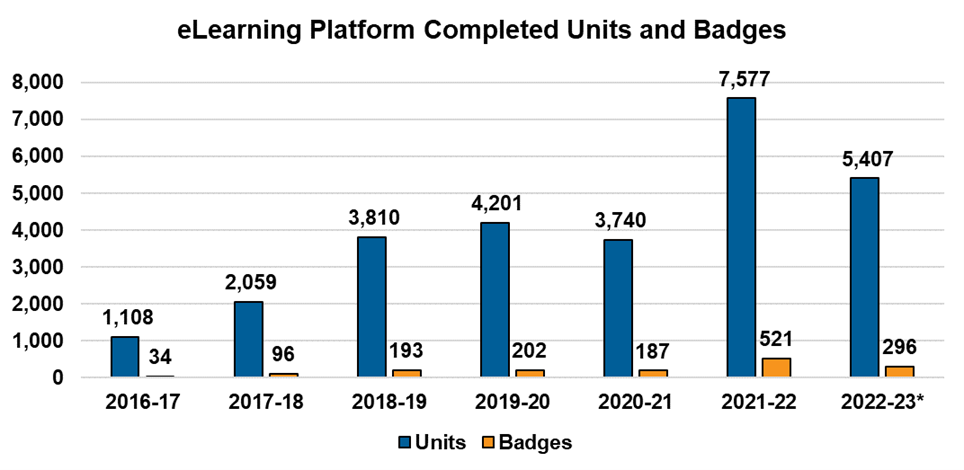
NCAN’s eLearning platform has also continued to receive strong use (see chart below). With 25% of the year left to go, the system has already recorded 71% of last year’s record-high unit completions. The most popular units remain those related to postsecondary admissions advising and financial aid.
Also related to professional development, NCAN’s Leading for Equity Fellowship for rising leaders of color completed its first year in December and in January welcomed a new cohort of 12 fellows. NCAN is grateful to UBS for supporting the first two years of the fellowship and to Kristen Crockett for her gifted leadership and facilitation. The first year of the program ran from January through December 2022. The fellows met virtually in three-hour sessions twice per month. Sessions included facilitation and learning, discussions, breakout
sessions, guest speakers, and networking, and topics ranged widely from, for example, emotional intelligence and imposter syndrome to fundraising, building team culture, and supporting a board of directors. By the end of 2022, 10 of the 12 fellows had been promoted or hired into a new position.
Qualitative feedback from the fellows found high levels of satisfaction with the experience. In the words of one fellow:
“This is absolutely an incredible investment in diversifying the top leadership in our organizations and is in my opinion having exactly the effect hoped—of increasing the impact that BIPOC leaders can have in our industry. Now, in my new role, I can use my expertise and training and lived experience to impact student programming, equity initiative, and most importantly, staff development for other BIPOC folks on my team and in my organization.”
Additionally, NCAN received two new grants during 2022-23 to support member services related to student mental wellness (ECMC Foundation) and supporting the postsecondary transition for students with learning differences (Oak Foundation). Both grants support small member regrant programs and technical assistance as well as professional development for the entire NCAN membership.
Also, this year NCAN began the lengthy process of supporting implementation of the FAFSA Simplification Act passed by the US Congress in December 2020. The new Better FAFSA, which will open in December 2023, is a long-awaited and most consequential overhaul
of the student financial aid application process since the application went online in 1997. By reducing the number of questions students and parents must answer, the Better FAFSA promises to decrease application completion time, increase the number
of applicants and the proportion of complete applications, increase the number of students receiving Pell Grants, and increase available time that students, parents, school counselors, and college access and success advisors can spend on other important
aspects of postsecondary planning and enrollment. This new application will also increase the number of students qualifying for the maximum Pell Grant and restore eligibility to students with drug convictions and individuals who are incarcerated.
Estimates from the US Department of Education (ED) are that “new eligibility formulas and funding are estimated to increase Pell Grant recipients
by nearly 15%.” As we all know, increased aid is key not only to increasing enrollment, but also persistence and degree completion.
To fulfill this promise, however, it is imperative that all those who help students with FAFSA completion understand the new application and how it will change their existing FAFSA completion support strategies. With the support of the Bill & Melinda Gates Foundation, Kresge Foundation, Scheidel Foundation, and Strada Education Foundation, NCAN is providing a robust suite of news, training, and communications resources to the field. We are also conducting outreach to
the media and other national associations to build awareness of the changes coming to the FAFSA.
In other fundraising news, NCAN received renewed grant support of $500,000 over two years
from the Carnegie Corporation of New York. The Carnegie Corporation provides unrestricted funding to underwrite NCAN’s member services, allowing dues to remain low and increasing participation
from a diverse group of organizations across the country. This work is the cornerstone of NCAN, allowing thousands of individuals around the country to learn together how to help more students more effectively. Without our members and their expertise,
NCAN could be neither a persuasive policy advocate nor a credible proponent of systems change.
Travelers also supported NCAN with a $50,000 defraying the cost of NCAN membership and conference attendance for 23 organizations that are Travelers EDGE partners.
In staffing news, NCAN welcomed Simone Pringle as new Member Services Coordinator and Matthew Odom as Communications
Manager. Our Communications Interns this year were Maira Ramos and Nhan La, both first-generation college-goers
who graduated with their bachelor's degrees in May.
Advocating for Policy Solutions
In policy news, this was a significant year for progress toward NCAN’s goal of doubling the Pell Grant. In December, Congress approved a $500 increase to the maximum Pell Grant for the 2023-24 award year, bringing the maximum award to
$7,395. This substantial increase follows last year’s increase of $400, the two greatest Pell boosts since the 2009-10 award year. This large growth in the maximum Pell Grant comes at a good time, since college enrollment
has not yet rebounded to pre-COVID-19 levels.
After three long years and four virtual advocacy weeks, NCAN convened members and students on April 26-27 in Washington, DC, for two days of advocacy skill-building sessions and discussions of key priorities with federal policymakers. Students, practitioners,
and advocates engaged in interactive exercises to prepare for meetings with members of Congress. NCAN also hosted a panel discussion featuring two professional staff of the House and Senate education committees, Viviann Anguiano and Mary Christina
Riley, as well as Lindsey Tepe, an advisor with the Office of Postsecondary Education at ED.F Additionally, a group of NCAN members met with officials from ED and the Office of Federal Student Aid (FSA) on timely issues including the implementation
of the forthcoming Better FAFSA and other guidance that could impact the work of our membership.
Speaking of the Better FAFSA, NCAN spent considerable time and energy during 2022-23 informing its development and keeping other stakeholders apprised of potential changes. Since fall 2021, NCAN staff have met with FSA every two weeks along with representatives
of the National Association of Financial Aid Advisors (NASFAA) to generate ideas and provide feedback. The FSA-NCAN-NASFAA implementation meetings allow for FSA to share ideas and concepts being considered. NCAN and NASFAA provide on-the-spot feedback
about the feasibility of the proposed work. There have been many instances where our suggestions have been utilized in the continued development of the form and process.
To assist NCAN in providing valuable feedback to FSA, we convene a monthly meeting of several highly experienced NCAN members who lead FAFSA completion/training efforts at their organizations. The group discusses the latest information available from
FSA and offers feedback about the new process/form and how it will affect those participating in the FAFSA completion process. This group includes:
Also related to Better FAFSA, NCAN keeps key stakeholders and policymakers informed about developments and relays feedback to FSA. NCAN meets quarterly with representatives from the following organizations: State Higher Education Executive Officers Association
(SHEEO), National Association of State Student Grant and Aid Associations (NASSGAP), American Association of Community College Trustees (AACCT), American School Counselor Association (ASCA), National Association for College Admission Counseling (NACAC),
National Council for Community and Educational Partnerships (NCCEP), and Council for Opportunity in Education, as well as several state financial aid administrators/representatives of state agencies that administer state grant aid programs. NCAN convenes
this group to discuss FAFSA simplification Implementation and solicit their input on the implementation process, training needs, and updates that may help inform FSA about the needs from the field. NCAN also meets with Congressional staff to share
information about Better FAFSA development.
In other policy work this year, NCAN has launched our efforts to increase support for state-level policies that will increase postsecondary access and success. To that end, we started new state policy working groups on:
Implementing universal FAFSA (12 states have now adopted it).
Reforming state financial aid.
Expanding access to higher education for students who are undocumented.
Addressing food insecurity.
Accelerating college completion.
In support of these state efforts, NCAN has received new grants from the Joyce Foundation and Strada Education Foundation
to build member capacity for state policy advocacy. The Charles Stewart Mott Foundation also renewed its support for NCAN to provide information and professional development related to state-level
child savings account programs designed to increase postsecondary aspirations, access, and success.
NCAN also updated and promoted our three major “data you can use” resources. NCAN’s FAFSA Tracker for the high school Class of 2023 received 44,500 views between
October 2022 and May 2023 and continues to be cited regularly on the topic of FAFSA completion rates. Our Growing Gap research found that for the average Pell Grant recipient in
2019-20, just 24% of public four-year colleges/universities and 40% of public two-year community colleges were affordable. Finally, our Pell Dollars Left on the Table report found that the high school class of 2022 left about $3.6 billion in Pell Grants on the table by not completing the FAFSA.
In staffing news, NCAN welcomed Catherine Brown as Senior Director of Policy and Advocacy.
Supporting Strong Systems
With a $3.3 million grant over three years from the Bill & Melinda Gates Foundation, NCAN is focused on state-level changes in policy and practice that will help many more students of color and students from low-income backgrounds make the transition
from high school to postsecondary enrollment. The Postsecondary Pathways Project has two main components:
Identifying and documenting state-level progress in advancing effective college and career readiness practices, with an emphasis on data sharing and usage.
Curating, producing, and promoting new and existing K-12 resources and channeling them to states, districts, community-based organizations, and partnerships that deliver supports to students.
In the first year of this project, NCAN partnered with 15 state-level members to identify high-leverage
policies and practices, create partnerships that can promote and implement them, and increase the number of schools providing, and students accessing, effective, affordable advising solutions. We also selected 15 College and Career Readiness Fellows to receive professional development to grow into more effective leaders in their schools, communities, and states. Fellows also act as an on-the-ground resource for NCAN to receive feedback
on various K-12-focused resources. Through communication with the fellows, NCAN was able to produce materials that are responsive to specific needs identified by practitioners themselves.
In order to support strong systems, NCAN also has to have recommendations to make to them about what to change and how to improve. NCAN identified eight of these policy levers and is focused on how states adopt and advance them. They are:
Provision student-level FAFSA completion data to local education agencies.
Use statewide National Student Clearinghouse contracts to provision postsecondary outcomes data.
Implement universal FAFSA policies that increase FAFSA completion.
Designate a state-level agency, initiative, or campaign with responsibility for college and career readiness programming.
Shift state financial aid programs toward need-based, rather than merit-based, awards.
Increase the share of states’ budgets invested in higher education.
Allow DREAMers to access state grant aid programs.
Expand dual enrollment policies to increase high school students’ early access to college coursework.
On an interactive dashboard, NCAN regularly updates states’
conditions according to each of these levers. Categorizing where states are, and describing how they can move up to the next category, allows for us to examine shifts in state-level college and career readiness policy, applaud advances in policy,
and try to prevent reforms that would adversely impact students.
One major benefit of this project has been the ability to collaborate with NCAN’s policy team on intersecting issues such as legislative adoption of universal FAFSA, which can lead to many more high school seniors completing the FAFSA and learning about
their eligibility for need-based financial aid. The ability to combine a policy approach with on-the-ground implications for students and school personnel has been important.
With the advice of state partners, NCAN has developed a menu of trainings to state agencies, districts, and schools. These include topics like:
Making Sense of Your National Student Clearinghouse StudentTracker® for High Schools Report: What Do I Do Now?
Start Your Year Off Right by Refreshing Your College and Career Toolbox
FAFSA Completion Trends, Policies, and Practices in [State] and Beyond
Supporting Student Success through a Thoughtful Data Strategy
Freezing Summer Melt: Strategies and Supports for Making Sure Students Get to Campus
We will continue to offer this set menu of trainings to statewide audiences and to develop additional presentations.
One notable project highlight was the opportunity to present at Idaho’s first-ever statewide FAFSA Summit on March 14, an experience we describe in this article. It was a tremendous experience and represented the potential and promise of cross-sector collaboration. NCAN hopes to participate in similar summits in other states and already presented at North Carolina’s Summit
in June and Arizona’s in July. We are also in conversation with several other states and the American College Application Campaign about other potential state FAFSA summits.
Our work around strong systems has the potential to engage regions, states, and communities in policy and practice changes at-scale. NCAN hopes that developing relationships with policymakers and practitioners doing work at this level can meaningfully
shift the experiences students have and the supports that they receive. This work also allows us to grow the NCAN membership into new sectors, which can surely benefit from the expertise developed by our members across the country.
Thought Leadership and Communications
With the pandemic in the rearview mirror for most media outlets, 2022-23 was somewhat quieter on the press front. Still, we ended the year with a strong call to action for supporting students of color in light of the Supreme Court’s decision to ban race-conscious college admission. Those of us who work in postsecondary access and success know that despite some progress, white students
remain far more likely than Black and Latino/a learners to both begin and complete a postsecondary degree. We have not done nearly enough to change higher education so that students of color and students from low-income backgrounds succeed at similar
rates as their White peers. It has never been more urgent for policymakers and higher education institutions to reimagine how they engage and support these students.
Additional top coverage featuring NCAN voices and data this year included:
NCAN spent much of the year undertaking a strategic planning process for 2023-26, facilitated by Bellwether. We referred to the process as a strategic “refresh” because we believed we had the right strategy areas in place. We will present the complete
plan this fall but note a couple of highlights from the conversation.
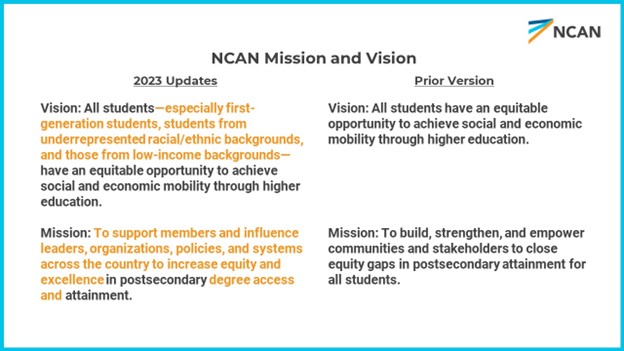
First, NCAN updated our vision and mission statements to explicitly reference racial and ethnic equity and made additional changes to clarify the scope of our work, as shown in the graphic below.
Second, NCAN’s new plan provides more clarity about the postsecondary outcomes we support students to achieve. Because data shows that a postsecondary degree is the strongest path to equity in economic and social mobility, we focus our direct policy,
practice, and systems work on pathways to access and attain postsecondary degrees, including pathways beyond immediate post-high school matriculation. We honor the agency and choices of students and families in knowing what is best for them. We celebrate
members’ work to help students and families understand and weigh the full range of postsecondary options most aligned to those preferences. We commit to equip members and their students with information to make informed decisions that optimize their
outcomes. We intend for this explication to better inform our members, partners, and potential partners about the scope of our work.
At the board level, NCAN welcomed four new board members and said goodbye to three: Paul Luna of the Helios Education Foundation (term limited after nine years of service), Amy Kerwin of Ascendium Education Group (resigned due to retirement) and Tina Fernandez of Achieve Atlanta (resigned due to job change). Bernard McCune and Doug Shapiro were voted onto the board by the NCAN membership in September and Braulio Colón and Ruth Watkins were appointed to fill the unexpired terms of the two members who resigned in late 2022.
NCAN continued our internal diversity, equity, and inclusion work in several ways. We administered a third year of the Promise54 Staff Experience and Organizational Profile Surveys,
which allowed us to understand where staff experience varies by race and to benchmark against other education nonprofits. These tools provide the basis for meaningful and challenging staff conversations and planning for action steps.
We also assessed the equity of our salaries and compensation philosophy, contracting externally for a salary benchmark review. We used those results to reassess some job titles and descriptions and as the basis to commit to phasing in salary adjustments
where needed to be more equitable.
One major related undertaking this year was the development of a new performance management system that clearly defines the skills necessary to grow from one job level to the next and that establishes a four-point competency rubric for evaluation. The
system will help staff better understand their performance and pathways for professional growth. It will also help managers give clearer feedback. NCAN also launched every-other-month affinity groups for staff of color and aspiring allies with a guided
learning agenda.
NCAN staff participated in an all-hands diversity, inclusion, and accessibility retreat facilitated by Kristen Crockett. The day included team-building exercises (have you ever built a tower out of spaghetti and marshmallows?) and the Clifton Strengths assessment and conversations about
how we work together across different strengths. As part of the follow up to those conversations, we launched affinity groups for Aspiring Allies and People of Color to continue building skills and abilities to work together from our perspectives.
We also welcomed Joy King as Chief of Strategy, Talent, and Operations, a new job description dedicated to culture-building, continued diversity, inclusion, and accessibility growth staff development and advancement, as
well as strategy management and building our infrastructure to support a growing staff and field.
Financially, NCAN continued to perform well despite inflation in several expense categories. In FY23, revenue exceeded expenses by $387,000. NCAN's unrestricted net assets at year-end were $327,000 less than at the end
of FY22, primarily due to increased in-person conference expenses and timing of grant payments. NCAN’s revenue was comprised of 35% earned income from dues, events, and contracts and 65% grant income. These are unaudited figures that NCAN will update
after our fall 2023 audit. In FY24, NCAN is on track to balance revenue and expense and to maintain or increase unrestricted net assets.

 Email to a Friend